 EN
EN
 English
 日本語
日本語 Español
 Deutsch
 عربى
عربى
Shelf life on a frozen food product is not a fixed property of the food—it is largely a property of the package. Two identically processed portions of frozen salmon, one in a high-barrier multilayer bag and one in a standard polyethylene freezer bag, will arrive at the consumer in measurably different condition after six months of frozen storage. The difference is barrier performance.
Barrier packaging for frozen food is the engineering discipline of selecting and structuring materials that slow or stop the transmission of oxygen, water vapor, light, and odor through the package wall. Understanding how this works—and how to specify it correctly—is one of the most commercially important decisions a frozen food brand can make.
Content
What Barrier Packaging Actually Does
Every flexible packaging film is permeable to some degree. Gas molecules, water vapor, and light all pass through polymer films at rates determined by the film's chemical composition, thickness, and physical structure. The practical question is not whether permeation occurs, but how fast—and whether that rate is slow enough to protect the product for its intended shelf life.
Oxygen transmission is the most consequential barrier property for most frozen food applications. Oxygen accelerates lipid oxidation in fats and oils, producing the rancid flavors and off-odors that make premium frozen meat, fish, and prepared meals taste stale before their expiration date. Even at freezer temperatures, oxidation continues—more slowly than at ambient temperature, but at a rate that matters over a six- to twenty-four-month frozen shelf life.
Moisture barrier performance determines whether a package prevents freezer burn. Freezer burn is the result of moisture migrating out of the food, through the package wall, and depositing as ice crystals on the exterior of the package or at cold spots within it. Films with poor moisture barrier allow this migration to occur continuously throughout storage, progressively drying out the food surface and degrading texture, color, and flavor.
Light and odor barriers matter for specific categories. Light accelerates photochemical degradation in fats and pigments; opaque or metallized films block this pathway entirely. Odor barrier is critical in retail freezer environments where multiple product categories are stored together—a package that allows odor crossover between adjacent products creates a consumer quality complaint that no amount of food science can fix after the fact.
The Two Numbers That Matter: OTR and WVTR
Barrier performance is quantified through two standardized measurements that appear on every technical film data sheet.
OTR (Oxygen Transmission Rate) measures the volume of oxygen that passes through a defined area of film per unit time under standard conditions, typically expressed as cc/m²/24hr at 23°C and a specified relative humidity. A lower OTR means better oxygen barrier. Films used for high-barrier frozen food applications—particularly red meat, seafood, and high-fat products—typically require OTR values below 5 cc/m²/24hr; the most demanding applications specify values below 1 cc/m²/24hr. In the United States, OTR testing is standardized under ASTM D3985, the benchmark method used by film suppliers and independent packaging laboratories to report and compare barrier performance.
WVTR (Water Vapor Transmission Rate) measures moisture passage through the film, expressed in g/m²/24hr. For frozen food, low WVTR is essential—moisture passing through the film in either direction contributes to freezer burn and package condensation. Testing is standardized under ASTM F1249.
One critical nuance: OTR and WVTR interact with relative humidity in ways that matter for specification. EVOH—the most common high-barrier resin in food packaging—provides outstanding oxygen barrier under dry conditions but loses a significant portion of that barrier performance when humidity exceeds 75%. In frozen storage at very low temperatures this is rarely a problem, but it becomes relevant during temperature cycling, distribution, and thawing. Understanding how the barrier behaves across the full product lifecycle, not just in static storage, is what separates a well-specified package from one that fails in the field.
Key Barrier Materials in Frozen Food Packaging
High-performance frozen food packaging is almost never a single material. It is a multilayer structure in which each layer contributes a specific functional property. Understanding what each material brings to the structure makes material selection logical rather than arbitrary.
Polyethylene (PE). The workhorse of flexible food packaging. PE provides the heat-sealable inner layer that bonds the package closed, the low-temperature flexibility needed to survive frozen distribution, and a baseline level of moisture resistance. On its own, PE offers poor oxygen barrier—it is the structural and sealing material in the composite, not the barrier material.
Polyamide (PA / Nylon). PA layers contribute puncture resistance and toughness—the properties that prevent bone-in cuts, shellfish, and irregularly shaped frozen products from penetrating the package wall. PA also provides a moderate oxygen barrier contribution and improves the film's ability to maintain its integrity under the mechanical stresses of vacuum packaging and frozen handling.
EVOH (Ethylene Vinyl Alcohol). The primary oxygen barrier layer in most multilayer coextruded food packaging films. EVOH delivers OTR values orders of magnitude lower than PE or PP, enabling the extended shelf life required for premium frozen meat, seafood, and ready meal applications. It is sandwiched between outer structural layers in coextruded structures to protect it from moisture, which degrades its barrier properties. Our high-barrier thermoforming film with excellent barrier function incorporates this EVOH-based multilayer architecture, delivering the low OTR performance required for demanding frozen food applications.
Aluminum foil. The ultimate barrier material—essentially zero OTR and WVTR when intact. Aluminum foil laminates are used where the maximum possible barrier is required regardless of cost or transparency. The trade-off is opacity (no product visibility), reduced flexibility at very low temperatures, and incompatibility with microwave cooking. For premium frozen meals where product visibility is not a retail priority, foil laminates remain a compelling specification.
PET (Polyethylene Terephthalate). PET outer layers provide printability, stiffness, and abrasion resistance to the outer surface of the film structure. In oriented form (OPET/BOPET), PET contributes moderate oxygen and moisture barrier alongside its structural benefits. It is the standard outer layer in most printed laminate structures for frozen food retail packaging.
Multilayer Film Structures: How Layers Work Together
A typical high-barrier frozen food film contains five to eleven layers, each assigned a specific functional role. The logic follows a consistent pattern: outer structural and print layers, tie layers that bond incompatible materials, barrier layers at the core, and inner sealing layers that contact the food.
A representative structure for a high-barrier vacuum frozen food bag might look like this: BOPET outer (print surface and abrasion resistance) / adhesive / PA (puncture resistance and moderate O₂ barrier) / EVOH (primary O₂ barrier) / PA / adhesive / PE inner (heat seal and food contact). Each interface between dissimilar materials requires a tie or adhesive layer to maintain structural integrity under the stresses of vacuum, freezing, and distribution.
Coextruded structures, where all layers are produced simultaneously in a single extrusion process, offer cost and performance advantages over adhesive laminates for many frozen food applications. Coextrusion eliminates adhesive layers between functional layers, producing a more uniform film structure with predictable barrier performance. Our PA/PE general barrier thermoforming film is a practical example of this coextruded architecture, providing reliable barrier performance in a structure optimized for thermoform packaging lines processing a range of frozen food products.
The number of layers is not the defining quality metric—functional performance is. A well-designed five-layer structure can outperform a poorly specified nine-layer one. Specifying by OTR and WVTR target values, then selecting the film structure that meets those targets at the right cost point, is the correct sequencing of the decision.
Matching Barrier Level to Product Type
Not every frozen food product needs the same barrier specification. Over-specifying adds cost without benefit; under-specifying causes quality failures. The right approach is to match barrier level to the product's specific degradation risk profile.
Premium red meat and poultry. High-fat cuts and ground meat are highly oxygen-sensitive. Rancidity develops faster than for most other frozen products, and the visual impact of freezer burn on red meat is immediately apparent to consumers. These products warrant high-barrier structures with OTR below 5 cc/m²/24hr and robust puncture resistance for bone-in cuts. Vacuum packaging combined with high-barrier film is standard for retail-quality frozen meat.
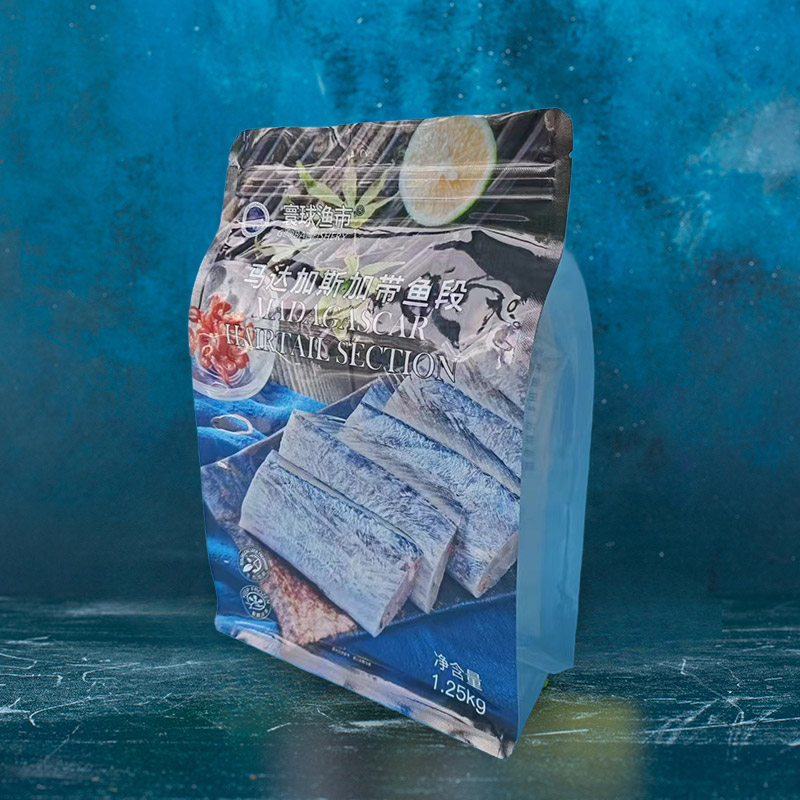
Fish and seafood. The most demanding application in terms of oxygen sensitivity. Polyunsaturated fatty acids in most commercial fish species oxidize faster than the saturated fats in red meat, making rancidity the primary quality risk. Our high-barrier frozen seafood bag is engineered for exactly this requirement—high OTR barrier, excellent low-temperature seal integrity, and the puncture resistance needed for shellfish and whole fish packaging.
Frozen pet food. Commercial frozen pet food—raw meat diets, frozen dog food rolls, and similar products—faces the same oxygen and moisture challenges as human food, but with longer expected shelf lives and often more demanding distribution conditions. Moisture and oxygen barrier are both critical, as is the structural integrity to survive bulk handling. Our moisture-proof and oxygen-proof frozen dog food bag addresses these dual barrier requirements in a format designed for the specific handling conditions of frozen pet food distribution.
Vegetables, fruits, and IQF products. Lower lipid content means reduced oxidation risk, but moisture barrier remains essential to prevent surface ice crystal formation and clumping. General-barrier PA/PE structures are typically adequate, with high-barrier EVOH-containing films reserved for premium or extended shelf life specifications.
Ready meals and prepared foods. Barrier requirements vary based on ingredient composition. Meals containing high-fat sauces, meat, or fish components require higher oxygen barrier than vegetarian options. Dual-ovenable packaging—used for products cooked in the original package—must balance barrier performance with the thermal stability required for oven use, making material selection more complex than for standard frozen packaging.
Custom Printing and Branding on Barrier Films
High barrier performance and high-quality print are not mutually exclusive. Modern multilayer film structures integrate printable outer layers—typically BOPET or BOPP—that accept rotogravure or flexographic printing at commercial quality while the barrier layers within the film structure do their job independently of the print surface.
The outer print layer is the consumer-facing surface. For frozen food retail, it carries brand identity, nutritional information, cooking instructions, and the visual signals that drive purchase decisions in the freezer aisle. A transparent window in an otherwise printed film allows product visibility—a feature that consistently improves consumer confidence in quality for fresh-frozen meat, seafood, and vegetable products.
Opaque or metallized films sacrifice product visibility in exchange for maximum barrier and a premium shelf presence. Metallized structures provide near-foil barrier performance at lower cost and weight than true aluminum foil laminates, and their reflective surface creates a distinctive retail appearance that many premium frozen food brands favor.
Custom printed barrier film rolls allow high-volume frozen food producers to integrate branding directly into the packaging material, eliminating secondary labeling steps and reducing per-unit packaging cost at scale. Our custom printing film roll for frozen food combines low-temperature resistance, puncture resistance, and full custom print capability in a single film format—enabling brands to deliver consistent barrier protection and shelf-ready presentation without compromise between the two.