 EN
EN
 English
 日本語
日本語 Español
 Deutsch
 عربى
عربى
Selecting the right packaging bags for dog food requires a material structure that blocks moisture, oxygen, and light while providing a resealable closure that preserves kibble freshness after opening. The optimal construction pairs food-grade LDPE inner layers with a high-quality aluminum foil barrier, laminated into a multi-layer film that meets food safety standards. A sliding zipper mechanism integrated into the bag allows the consumer to open and reseal the package repeatedly without losing the barrier protection, a feature that directly extends the shelf life of dry dog food from days to weeks after the initial opening. Since 2011, professional pet food packaging manufacturers have refined these designs across size ranges from 1kg box pouches to 20kg side gusset bags, creating a complete packaging solution that covers single-meal trial packs, weekly supply bags, and bulk economy formats.
Content
- 1 Material Structure and Barrier Performance
- 2 The Sliding Zipper: Resealability Without Barrier Compromise
- 3 Bag Formats and Size Range from 1kg to 20kg
- 4 Food Safety Certifications and Manufacturing Standards
- 5 Custom Printing and Brand Differentiation
- 6 Application Across Pet Food Categories
- 7 Sustainability Considerations in Multi-Layer Bags
- 8 Selecting a Certified Packaging Partner
Material Structure and Barrier Performance
The layered architecture of a dog food packaging bag is engineered to arrest the three agents that degrade dry pet food: atmospheric oxygen, ambient moisture, and UV light. Oxygen initiates lipid oxidation in the fats and oils coating the kibble, producing rancid off-flavors that dogs detect and reject. Moisture absorption softens the crunchy texture and creates conditions for mold growth. Light accelerates both processes. A properly specified bag addresses all three threats through its material stack.
The LDPE-Aluminum Foil Laminate Structure
The outermost layer is typically a reverse-printed PET film that carries the brand graphics and provides scratch resistance. Beneath this sits the aluminum foil layer, which is the functional heart of the barrier. Aluminum foil with a thickness of 7 to 12 microns reduces oxygen transmission to effectively zero and water vapor transmission to below 0.1 g/m² per 24 hours at 38°C and 90% relative humidity. The inner layer contacting the food is food-grade LDPE, a low-density polyethylene that is heat-sealable, chemically inert, and compliant with FDA and EU food contact regulations. This LDPE layer also provides the toughness that prevents punctures during transport and the flexibility that allows the bag to be compressed and rolled down as the contents are consumed. The three layers are bonded with solvent-free polyurethane adhesives that do not migrate into the food product.
| Layer | Material | Function |
|---|---|---|
| Outer Print Layer | PET, 12 microns | Print surface, abrasion resistance |
| Barrier Core | Aluminum Foil, 7–12 microns | Zero oxygen, moisture, and light transmission |
| Inner Sealant Layer | Food-Grade LDPE, 50–80 microns | Heat seal, food contact safety, puncture resistance |
This structure is not the only option but it is the standard for dry dog food requiring a shelf life of 12 to 18 months. For products with a shorter intended shelf life or those packaged in smaller formats, a metallized PET layer can substitute for the aluminum foil, providing a moderate barrier at a lower material cost while maintaining a metallic appearance.
The Sliding Zipper: Resealability Without Barrier Compromise
A traditional press-to-close zipper relies on the consumer aligning two interlocking profiles and squeezing them together along the entire length of the opening. In practice, consumers often fail to seal the zipper completely, leaving a micro-gap that admits moisture and accelerates staleness. A sliding zipper eliminates this failure mode. The slider mechanism travels along the zipper track, physically forcing the male and female profiles into engagement as it moves. The user opens the bag by sliding the zipper in one direction and reseals by sliding it back, with an audible click or tactile stop confirming full closure. This mechanism adds approximately 10% to 15% to the bag unit cost but significantly extends the in-use shelf life of the product. For a premium dog food brand selling a 5kg bag at a retail price point where the consumer expects the food to remain fresh for four to six weeks after opening, the sliding zipper is not an optional upgrade; it is a necessary component of the product quality promise.
Zipper Application and Seal Integrity Testing
The zipper assembly is heat-sealed to the inner LDPE layer of the bag during the bag-making process, before the bag is filled. This seal must withstand the forces applied during slider operation without delaminating. A peel test on the zipper-to-film bond should exceed 30 Newtons per 15mm width. After the bag is filled and the top seal is closed, the entire package undergoes a leak test where it is submerged in water under vacuum to detect pinhole leaks at the zipper end seals or the laminate seams. A properly manufactured bag with an integrated slider zipper should show zero bubble streams at a vacuum of -0.04 MPa, confirming that the resealable feature has not introduced a barrier weakness at its attachment points.
Bag Formats and Size Range from 1kg to 20kg
Dog food packaging spans a wide weight range, and a single bag format does not serve all sizes efficiently. The packaging configuration must match the fill weight, the filling equipment, and the retail display method. Two primary formats cover the spectrum.
Box Pouches for 1kg to 5kg Formats
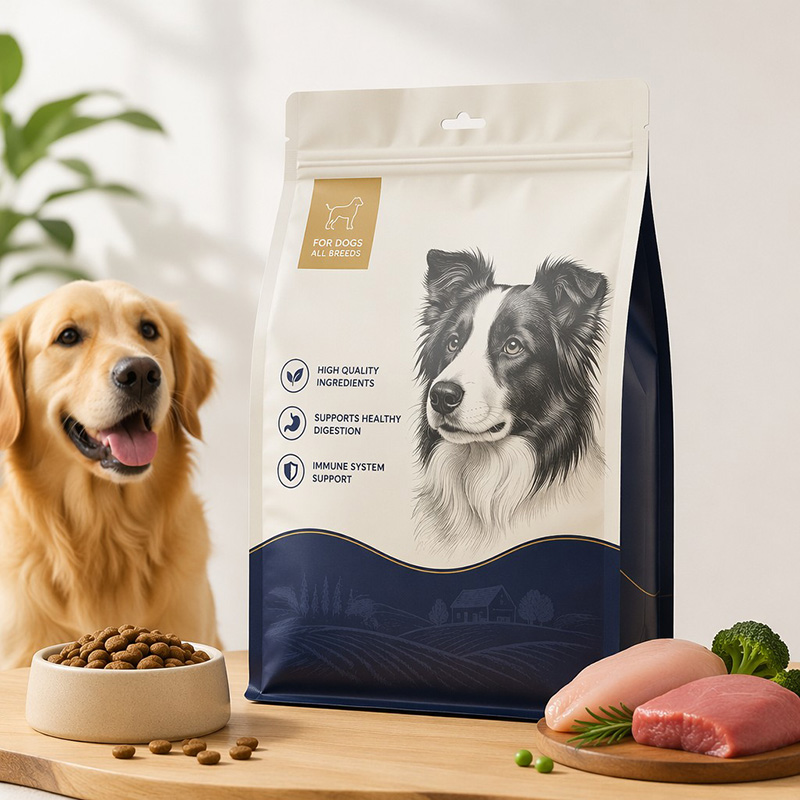
A box pouch, also known as a flat-bottom pouch or a quad-seal bag, has gusseted sides and a flat rectangular base that allows it to stand upright on a store shelf without a supporting rack. This format is ideal for 1kg to 5kg dog treat bags and small-breed dog food packs. The flat bottom panel provides a generous surface area for branding and nutritional information, and the gusseted sides expand to accommodate the product volume. The top can be fitted with a tear notch above the zipper or a laser-scored opening line that guides the consumer to a clean cut. Box pouches in this weight range are typically filled on vertical form-fill-seal machines adapted for pre-made pouches, running at speeds of 30 to 60 bags per minute depending on the fill weight and product flow characteristics.
Side Gusset Bags for 5kg to 20kg Bulk Formats
Side gusset bags, also called side-fold bags, have expandable folds running vertically along both edges, creating a wide, blocky shape when filled. This format is the industry standard for 5kg, 10kg, 15kg, and 20kg bulk dog food bags. The side gussets distribute the product weight evenly, preventing the bag from becoming cylindrical and rolling off pallets during storage. The top closure for bulk bags may use a slider zipper, a hook-to-hook zipper, or a sewn-on plastic handle strip that also functions as a reclosure. For the heaviest 20kg formats, a reinforced bottom gusset with an additional film patch prevents the bag from splitting when dropped from a tailgate height of 1.2 meters. The larger print area on these bags accommodates the detailed feeding guidelines, ingredient lists, and guaranteed analysis panels required by AAFCO and FEDIAF labeling regulations.
Food Safety Certifications and Manufacturing Standards
Pet food packaging occupies a regulatory space that is distinct from human food packaging but increasingly held to equivalent standards. Dog food bags must ensure that no substances migrate from the packaging into the food at levels that could harm the animal, and they must be manufactured in facilities that prevent contamination from pathogens, pests, and chemical hazards. Three certifications form the baseline for professional pet food packaging manufacturing.
ISO 9001 Quality Management
ISO 9001 certification, achieved in 2020 by established pet food packaging manufacturers, establishes a quality management system that governs the entire production process from incoming raw material inspection to finished bag shipment. Under this system, every batch of LDPE resin and aluminum foil is tested against a material specification before it enters production. In-process checks verify seal strength, zipper alignment, and print registration at predetermined intervals. Non-conforming product is segregated, root-cause analysis is documented, and corrective actions are tracked to closure. For a dog food brand, sourcing from an ISO 9001-certified bag supplier means the packaging quality is not dependent on a single experienced operator; it is embedded in a documented, auditable system that produces consistent results across production shifts and seasons.
BRC Global Standard for Packaging
The BRC Packaging standard is a Global Food Safety Initiative benchmarked certification that specifically addresses the risks in packaging manufacturing for food and pet food. BRC certification requires a hazard analysis and risk assessment of the manufacturing process, a documented prerequisite program covering facility hygiene, pest control, and personnel training, and a senior management commitment to food safety culture. The standard mandates that the manufacturing environment be segregated into risk zones, that glass and brittle plastic be excluded or controlled, and that the printing inks and adhesives used on the packaging be formulated from materials approved for indirect food contact. BRC-certified facilities undergo an annual unannounced audit, ensuring that the standards observed during the initial certification are maintained in daily operation, not just prepared for a scheduled visit.
HACCP Hazard Analysis
HACCP certification for pet food packaging identifies the specific points in the manufacturing process where a hazard—biological, chemical, or physical—could be introduced and establishes critical control limits at those points. For a bag-making line, a critical control point is the heat-seal temperature: if the temperature drops below the specified minimum, the inner LDPE layer may not fully fuse, creating a micro-leak path that could admit moisture or bacteria. The HACCP plan defines the temperature range, the monitoring frequency, the corrective action if the limit is breached, and the verification procedure that confirms the control measure is effective. This systematic approach to hazard prevention, rather than end-product testing, aligns with the preventive philosophy of modern food safety management.
Custom Printing and Brand Differentiation
The packaging bag is the primary consumer-facing communication medium for a dog food brand. On a pet store shelf or an e-commerce product page, the bag must convey the brand identity, the product benefits, and the flavor variant within the first second of visual contact. Custom-printed bags produced using rotogravure or flexographic printing achieve this with photographic image quality and Pantone-matched brand colors. The printing is applied to the reverse side of the outer PET layer before lamination, a technique called reverse printing that protects the ink from abrasion during shipping and handling. The print cylinder or plate costs are amortized over the production run, making custom printing cost-effective at order quantities above 5,000 to 10,000 bags per SKU.
Design Elements for Dog Food Bags
An effective dog food bag design integrates several mandatory elements with brand storytelling. The front panel carries the brand logo, the product name, the weight declaration, and the primary visual—often an appetite-appealing photograph of the kibble with ingredients like chicken, sweet potato, or blueberries. The back or side panel contains the guaranteed analysis, the ingredient list in descending order of inclusion, the feeding guidelines by dog weight, the AAFCO nutritional adequacy statement, and the manufacturer's contact information. A transparent window, created by omitting the aluminum foil layer in a defined area and substituting a clear barrier film, allows the consumer to see the actual kibble, a feature that builds trust at the point of sale. The slider zipper area should be printed with opening instructions and a reseal reminder, because a consumer who struggles to open the bag correctly may damage the zipper and lose the reseal function.
Application Across Pet Food Categories
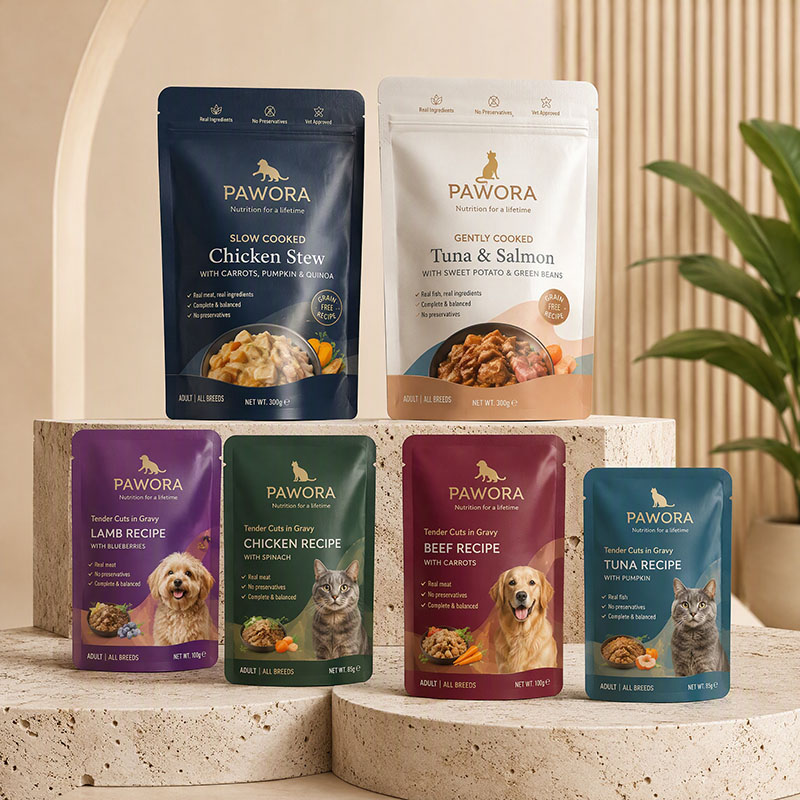
The bag construction designed for dog food adapts readily to other dry pet food products. Cat food packaging uses the same LDPE-aluminum foil laminate structure, typically in smaller formats of 1kg to 5kg box pouches, because cat food is sold in smaller bag sizes corresponding to the smaller animal's consumption rate. The sliding zipper is equally important for cat food, as feline owners are particularly sensitive to the aroma of stale or oxidized fish-based cat foods. Bird feed packaging applies the same barrier technology to seed mixes, where the aluminum foil layer prevents the oils in sunflower seeds and peanuts from oxidizing and the LDPE inner layer resists the sharp seed hulls that can puncture lesser films. A manufacturer with a broad pet food packaging capability can supply a multi-pet brand with a unified bag family—same material, same zipper, same print quality—across dog, cat, and bird product lines, simplifying the brand's supply chain and ensuring consistent packaging quality across categories.
Sustainability Considerations in Multi-Layer Bags
The aluminum foil-LDPE laminate that delivers superior barrier performance presents a recycling challenge because the dissimilar materials cannot be separated economically in standard recycling streams. The pet food packaging industry is responding with two approaches. The first is a move toward mono-material polyethylene structures where the barrier function is provided by a thin coating of aluminum oxide or silicon oxide deposited on the PET layer in a vacuum chamber, creating a transparent barrier film that is still classified as a single-polymer family for recycling purposes. These structures achieve oxygen transmission rates of 0.5 to 2.0 cc/m² per day, adequate for shelf lives of 9 to 12 months. The second approach is the incorporation of post-consumer recycled content into the LDPE sealant layer, typically at 30% inclusion, reducing the bag's virgin plastic footprint without affecting the food-contact surface because the recycled content is sandwiched between virgin LDPE skins. Brands should discuss their specific sustainability targets with the packaging manufacturer during the design phase, because the barrier requirements, shelf-life expectations, and available recycling infrastructure determine which sustainable structure is viable for a given product.
Selecting a Certified Packaging Partner
The decision to source packaging bags for dog food involves evaluating the manufacturer's certifications, production experience, and range of capabilities against the specific requirements of the product line. A partner that has been manufacturing pet food packaging since 2011 brings over a decade of accumulated knowledge about zipper failures, seal integrity issues, and print quality expectations specific to this product category. The ISO 9001, BRC, and HACCP certifications achieved in 2020 provide third-party verification that the manufacturing facility operates at a standard equivalent to human food packaging. The ability to produce both small-format box pouches and large-format side gusset bags from a single source simplifies procurement logistics and quality assurance. For a dog food brand launching a new product or redesigning its packaging, engaging the bag manufacturer early in the design process allows the package structure to be optimized for the specific product density, fill weight, and distribution channel, avoiding the costly redesign that follows a packaging failure discovered after the product reaches the market.