 EN
EN
 English
 日本語
日本語 Español
 Deutsch
 عربى
عربى
The right packaging for dog treats depends on whether you are storing homemade treats at home, selling treats as a small business, or packaging commercially at scale — but in every case, airtight containment is the non-negotiable baseline. For home storage, airtight dog treat containers in BPA-free plastic, glass, or stainless steel extend shelf life from days to weeks. For selling, stand-up kraft pouches with zip locks, window bags, or custom printed flat-bottom bags are the industry standard for dog treat packaging bags. Custom dog treat packaging — printed with your logo, flavor, and weight — is accessible at low minimums through digital printing services, and purpose-built dog biscuit packaging with resealable closures and clear windows is available from packaging wholesalers starting at a few hundred units. This article covers every scenario in practical detail.
Content
- 1 Why Packaging Matters for Dog Treats: Freshness, Safety, and Shelf Life
- 2 Airtight Containers for Dog Treats: Home Storage Options
- 3 Homemade Dog Treat Packaging: Storage and Gifting Options
- 4 Dog Treat Packaging Bags: Types for Commercial and Small Business Use
- 5 Custom Dog Treat Packaging: Branding on a Small Business Budget
- 6 Dog Biscuit Packaging: Formats for Rigid and Shaped Treats
- 7 Pet Medication Packaging: Requirements and Best Practices
- 8 Dog Treat Packaging Ideas: Differentiating Your Product
- 9 Choosing the Right Dog Treat Packaging: A Quick Reference Guide
Why Packaging Matters for Dog Treats: Freshness, Safety, and Shelf Life
Dog treats — whether homemade or commercial — contain fats, proteins, and moisture that degrade rapidly when exposed to air, light, and humidity. Understanding the spoilage mechanisms helps explain why packaging choices have such a direct impact on product quality and safety.
Fat Oxidation and Rancidity
The fats in meat-based treats, peanut butter biscuits, and liver snacks oxidize when exposed to oxygen, producing rancid flavors and potentially harmful peroxides. Oxygen is the primary enemy of treat freshness. A packaging material with a high oxygen transmission rate (OTR) — such as standard polyethylene film — allows approximately 3,000–5,000 cm³ of oxygen per m² per day to pass through, while a multi-layer barrier film with EVOH (ethylene vinyl alcohol) layer reduces OTR to below 1 cm³/m²/day. This difference alone can extend a soft treat's shelf life from 2–3 weeks to 6–12 months.
Moisture and Microbial Growth
Soft, semi-moist treats have water activity (Aw) above 0.70, which supports mold and bacterial growth at room temperature. Airtight packaging prevents moisture pickup from humid ambient air (which accelerates microbial growth in low-moisture treats) and prevents moisture loss from high-moisture treats (which causes hardening and texture degradation). Hard biscuit-type treats are more shelf-stable at Aw below 0.60 but will still soften and stale without moisture-barrier packaging.
Light and UV Degradation
UV exposure accelerates fat oxidation and degrades certain vitamins (particularly A, D, and riboflavin) in treat formulations. Opaque packaging or UV-blocking materials significantly extend shelf life for fat-containing treats displayed under store lighting or stored in bright kitchens. This is why many commercial dog treat packages are either fully opaque or use a metallic film layer that blocks UV — the clear window serves marketing purposes but is intentionally limited in area.
Airtight Containers for Dog Treats: Home Storage Options
For pet owners storing purchased or homemade treats at home, an airtight dog treat container is the most effective and economical freshness solution. The container type, material, and seal mechanism all affect how well treats are preserved.
What Makes a Container Truly Airtight
Not all containers marketed as "airtight" provide the same level of sealing. Genuinely airtight dog treat containers use one of the following seal mechanisms:
- Silicone gasket lid: A continuous silicone ring compresses against the container rim when the lid is closed, creating an oxygen and moisture barrier. This is the most reliable seal for home containers — look for containers with a visible silicone gasket rather than a simple snap-fit lid without a gasket.
- Clamp or latch closure: Metal or plastic clamps lock the lid tightly against the silicone gasket on all sides simultaneously — the same mechanism used on canning jars and food-grade storage containers. Provides a more consistent seal than a simple press-fit lid.
- Vacuum seal mechanism: Some premium dog treat containers include a one-way valve or pump mechanism that actively removes air from the container interior — reducing oxygen content to near zero. These extend soft treat shelf life most dramatically but are more expensive ($20–$50 vs. $8–$20 for standard airtight containers).
- Screw-top lid with gasket: Wide-mouth jar format with a threaded lid and inset silicone or rubber gasket. Common in glass and stainless formats — reliable seal, easy to clean, and hygienic for long-term use.
Airtight Container Materials: Plastic, Glass, and Stainless Steel
| Material | Odor Absorption | Durability | Dishwasher Safe | Typical Cost | Best For |
|---|---|---|---|---|---|
| BPA-free plastic (Tritan, PP) | Low–Moderate (scratches absorb over time) | High (shatterproof) | Usually yes (top rack) | $8–$20 | Everyday use; travel; homes with children |
| Glass (borosilicate or soda-lime) | None (non-porous) | Moderate (can break) | Yes (full cycle) | $12–$35 | Odor-free storage; strong-smelling treats; display jars |
| Stainless steel | None | Very high (dent-resistant) | Hand wash recommended | $20–$50 | Long-term durability; natural/eco households |
| Ceramic (with silicone lid) | None (if unglazed interior avoided) | Moderate (chip/break risk) | Usually yes | $15–$45 | Counter display; décor-focused households |
Sizing Airtight Dog Treat Containers
Container size should match the quantity of treats consumed within the treat's shelf life after opening — an oversized airtight container filled only halfway still holds significant air volume above the treats, reducing the effectiveness of the airtight seal. Practical sizing guidelines:
- Small dogs or infrequent treating: 500 ml–1 liter container; replenish weekly from a larger sealed bag stored in the pantry or freezer
- Medium dogs or daily training use: 1–2 liter container; enough for a standard 200–400g bag of treats
- Large dogs or multi-dog households: 2–4 liter container; look for wide-mouth openings that accommodate large biscuits and hands for easy scooping
- Countertop display jars: Keep only a 3–5 day supply in accessible containers; store the bulk of treats sealed in the original bag or a larger airtight container away from light and heat
Homemade Dog Treat Packaging: Storage and Gifting Options
Homemade dog treats require careful packaging because they lack the preservatives and controlled moisture levels of commercial products. Most homemade soft treats have a room-temperature shelf life of only 3–7 days; properly packaged in airtight containers in the refrigerator, they last 2–3 weeks; frozen in airtight packaging, 2–3 months.
Best Packaging for Homemade Treats You Plan to Use
- Airtight glass jars (Mason/Kilner style): The most hygienic option for refrigerated storage. The glass absorbs no odors, the metal lid with rubber gasket provides an excellent seal, and the transparent sides let you see treat condition at a glance. Standard wide-mouth pint jars (500 ml) are ideal for most homemade biscuit batches.
- Zip-lock freezer bags: For batch freezing, lay treats flat in a single layer in a labeled freezer bag, squeeze out all air before sealing, and freeze. Silicone reusable freezer bags (Stasher, Zip-Top) are an eco-friendly alternative that provides equivalent protection. Label with treat type and date — frozen treats look identical regardless of content.
- Vacuum seal bags: A countertop vacuum sealer (FoodSaver or similar) extends homemade treat shelf life dramatically — refrigerated treats last 4–6 weeks, frozen treats 6–12 months with vacuum sealing. The investment ($50–$120 for a basic sealer) pays back quickly for households making large treat batches.
Homemade Dog Treat Packaging for Gifting
Gifting homemade treats requires packaging that is attractive, informative (ingredients listed for dogs with allergies), and practical for the recipient. Popular options:
- Kraft paper treat bags with window: Available from craft and packaging suppliers in 100g, 200g, and 500g sizes; the kraft paper provides a natural, premium look; the clear window shows the treats inside. Seal the top with a fold-and-tape closure, heat sealer, or washi tape for a handmade aesthetic. Add a custom label with the dog's name, treat type, and ingredients.
- Treat tins and gift boxes: Metal tins with press-fit lids provide excellent airtight storage and a reusable container the recipient can continue using. Round tins in 150 ml, 500 ml, and 1 liter sizes are widely available from packaging wholesalers; decorate with a custom label or ribbon. Cardboard gift boxes lined with tissue are suitable for dry biscuits as a gift presentation but should be re-stored in airtight containers after opening.
- Printable kraft labels: A custom label on a standard packaging bag or jar transforms a simple container into a personalized gift. Print on kraft paper sticker stock with your pet's photo, "Baked with Love" messaging, ingredient list, and best-by date. Free templates are available on Canva; label sheets print on standard home inkjet or laser printers.
- Cellophane bags with ribbon: For dry biscuits intended for immediate consumption (party favors, adoption day bags), individual cellophane bags or small organza bags tied with ribbon are a low-cost, visually appealing presentation. Not suitable for shelf storage — cellophane provides minimal moisture barrier.
Dog Treat Packaging Bags: Types for Commercial and Small Business Use
For small businesses, cottage producers, and commercial manufacturers, flexible packaging bags are the dominant format for dog treat packages sold at retail. The bag format, material construction, and closure mechanism all affect product shelf life, shelf presence, and manufacturing cost.
Stand-Up Pouches (SUP)
Stand-up pouches with a gusset base are the most popular format for premium dog treat packaging bags. They stand upright on retail shelves without a tray, maximizing shelf visibility. Key specifications:
- Material construction: Standard SUPs for dog treats use a 2–4 layer laminate — typically a printed outer layer (PET or BOPP), a foil or EVOH barrier layer for oxygen and moisture protection, and an inner food-contact layer (PE or CPP). The barrier layer is what distinguishes premium dog treat packaging bags (6–12 month shelf life) from basic unlaminated bags (2–4 week shelf life).
- Zip-lock reseal: A press-to-close zipper at the top of the pouch is the standard reseal mechanism for dog treat packages. The zipper is heat-sealed during filling and first-opened by tearing a notch at the top. After opening, the zipper provides convenient reseal but is not as airtight as the original heat seal — advise customers to use a clip or store in a secondary airtight container after opening for best freshness.
- Tear notch and euro hole: A laser-cut tear notch ensures clean opening; a euro hole (die-cut oval at the top) allows hanging on retail peg hooks — both standard features in commercial dog treat packaging bags.
- Window options: A clear rectangle or oval window on the front panel allows consumers to see the product — particularly effective for visually appealing treats like shaped biscuits or multi-color treats. Windowed bags typically cost 5–15% more than fully opaque equivalents.
Flat-Bottom (Box Pouch) Bags
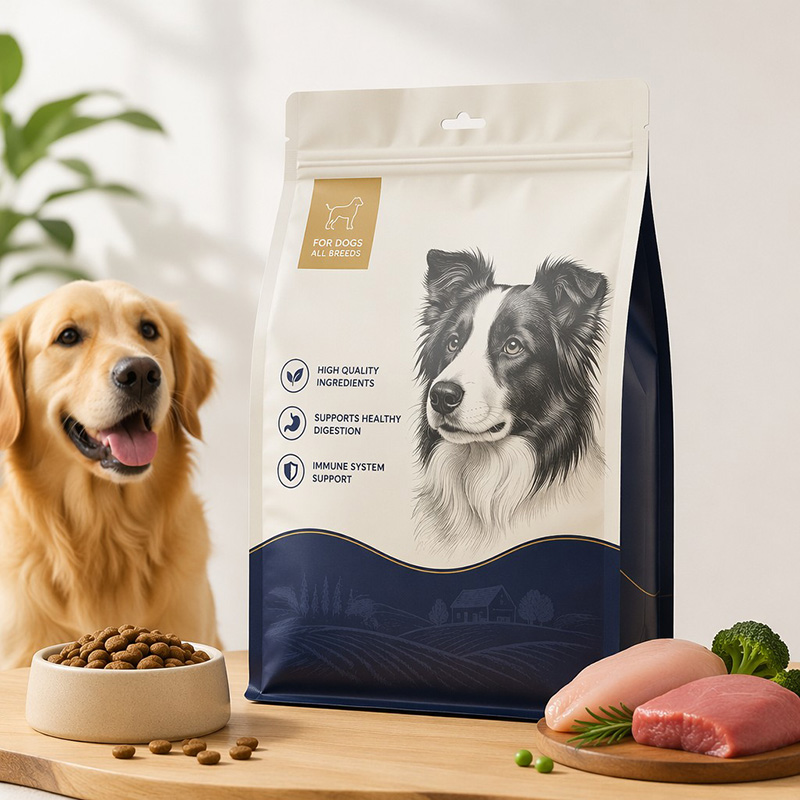
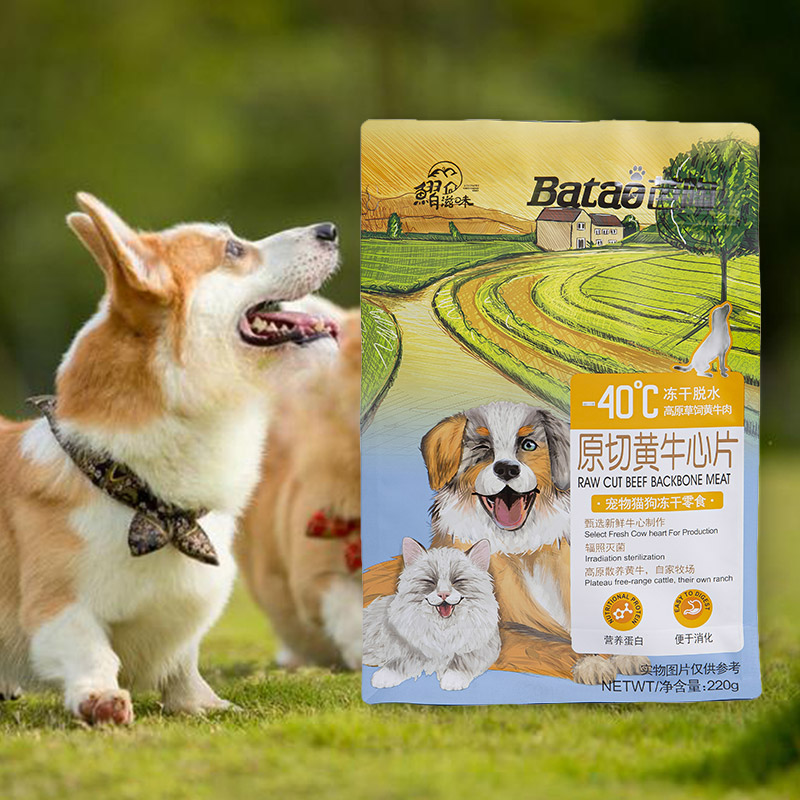
Flat-bottom bags have a structured rectangular base and four sealed side panels — they stand upright like a box and present more front-panel surface area than a standard SUP at equivalent volume. Increasingly popular for premium and natural dog biscuit packaging because the box-like appearance communicates quality and stability, and the larger printable surface allows more branding, ingredient, and lifestyle content. More complex to fill and seal than standard SUPs; typically require a semi-automatic or automatic fill-and-seal machine rather than manual filling.
Kraft Paper Bags and Eco-Friendly Formats
Kraft paper dog treat packaging bags are strongly preferred by natural, organic, and sustainability-focused brands. Available formats include:
- Kraft paper SUP with PE liner: Kraft outer layer laminated with a polyethylene inner for moisture resistance. Provides the natural paper appearance consumers associate with natural products while maintaining functional barrier protection. Recyclability depends on the municipality — mixed material laminates are not recyclable in most curbside programs.
- Compostable kraft pouches: Made from certified compostable films (NatureFlex, PLA, or paper laminated with compostable coatings). Suitable for certified compostable claims on packaging; barrier properties are lower than conventional laminates — best for products with short shelf life (under 3 months) or refrigerated distribution. Carry the highest per-unit cost of any flexible dog treat packaging format.
- Kraft paper pillow bags: Simple flat-seal bags with a heat-sealed top and bottom — the lowest-cost flexible packaging format. Suitable for dry biscuits sold fresh from bakeries or farmers markets with short shelf life. The top is folded and stapled with a header card for display purposes.
Dog Treat Packaging Bag Size and Fill Weight Guide
| Bag Dimensions (W×H×G mm) | Typical Fill Weight | Best Format | Best For | Approx. Unit Cost (printed, 1,000 units) |
|---|---|---|---|---|
| 90×140×50 | 50–100g | SUP with zip | Trial/sample packs, small soft treats | $0.25–$0.45 |
| 120×200×70 | 100–200g | SUP with zip + window | Standard retail treats, biscuits | $0.35–$0.60 |
| 160×250×90 | 200–400g | SUP or flat-bottom with zip | Premium biscuits, jerky treats | $0.50–$0.85 |
| 200×320×110 | 400g–1kg | Flat-bottom or large SUP | Bulk biscuits, training treats | $0.70–$1.20 |
Custom Dog Treat Packaging: Branding on a Small Business Budget
Custom dog treat packaging — with your brand name, logo, colors, flavor descriptions, and barcode — was previously accessible only to manufacturers ordering 10,000+ units. Digital printing technology has reduced minimum order quantities to 250–500 units for fully custom printed pouches, making custom packaging viable for small and micro dog treat businesses.
Custom Dog Treat Bags: Printing Methods
- Digital printing (inkjet or laser on pre-made pouches): The lowest MOQ option — some suppliers accept orders from 50–100 units. A digital print run produces each bag individually without plates, making short runs and design changes economical. Print quality is excellent for photographic imagery and complex gradients. Slightly higher per-unit cost than flexographic printing at equivalent quantities. Best for startups, product testing, and seasonal or limited editions.
- Flexographic printing: The standard commercial printing method for packaging films. Requires physical printing plates ($500–$2,000 per color) but produces lower per-unit costs at volumes of 5,000+ units. Up to 10 color process; consistent, fast production. Best for established businesses with stable designs ordering recurring large volumes.
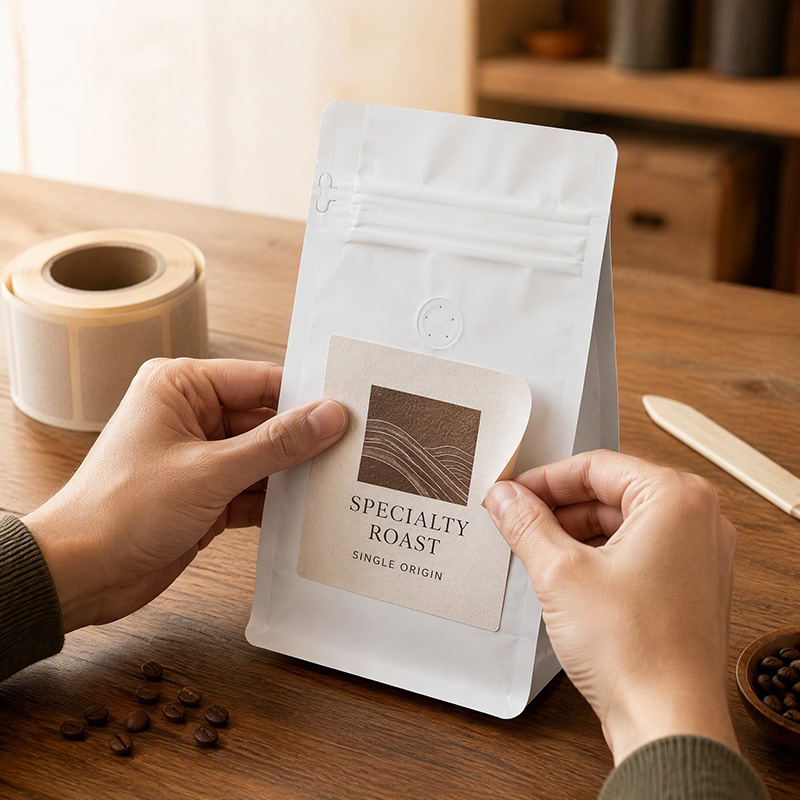
- Custom labels on stock bags: The most economical custom option for very small runs. Purchase blank kraft or clear SUP bags in bulk (often available for $0.10–$0.25 per unit at 500+ unit quantities) and apply custom printed labels. Labels can be printed on a desktop label printer (Dymo, Rollo) or professionally at a local print shop. Provides full customization at minimal investment but has a more handmade appearance than fully printed bags.
What Your Custom Dog Treat Packaging Must Include
Beyond branding, pet food packaging in most jurisdictions has mandatory labeling requirements. In the United States, the AAFCO (Association of American Feed Control Officials) model regulations and individual state pet food laws require:
- Product name and species designation: "Dog Treats" or "Snacks for Dogs" must appear prominently
- Net weight: Stated in the principal display panel in both US customary (oz/lb) and metric (g/kg) units
- Ingredient list: Listed in descending order by weight before processing, using AAFCO-approved ingredient names
- Guaranteed analysis: Minimum crude protein and fat percentages, maximum crude fiber and moisture percentages
- Manufacturer name and address: Full business name, city, state, and zip code (or country for international)
- Best-by or use-by date: Not always legally required for treats but strongly recommended for consumer confidence and liability protection
In the EU, pet food labeling is governed by Regulation (EC) No 767/2009. In Australia and New Zealand, the PFIAA (Pet Food Industry Association of Australia) voluntary standards and state-level requirements apply. Always verify current labeling requirements in your jurisdiction with a regulatory consultant or your state/national feed control authority before selling packaged dog treats.
Custom Dog Treat Bags: Supplier Options
- Noissue, Packhelp, Lumi: Digital-first packaging suppliers targeting small businesses; MOQs from 100–500 units; fully custom printed SUPs and flat-bottom pouches; online design tools available
- Alibaba / direct Chinese packaging manufacturers: Lowest per-unit cost for larger orders (2,000+ units); lead time 4–8 weeks; requires careful supplier vetting for food-grade certification and barrier film specification compliance
- Impak Corporation, Bagcraft Packaging, Clear Bags: North American packaging distributors stocking food-grade pouches in stock and custom formats; suitable for small-medium volumes with faster lead times than overseas manufacturers
- Etsy packaging suppliers: Handmade and boutique-scale dog treat packaging suppliers on Etsy offer very small MOQs (25–100 units) of blank and lightly customized kraft treat bags — suitable for cottage producers and gift makers
Dog Biscuit Packaging: Formats for Rigid and Shaped Treats
Dog biscuits — hard, baked, shaped treats — have different packaging requirements from soft chews or jerky. Their rigidity means they can be packaged in formats that soft treats cannot, and their lower moisture content gives them a longer inherent shelf life that reduces the urgency of extreme barrier protection.
Pillow Bags and Flow Wrap
The most common commercial dog biscuit packaging format is the horizontal form-fill-seal (HFFS) pillow bag — a simple sealed pouch formed around the biscuits on a flow wrapper. These are fast to produce (1,000+ packs per minute on high-speed lines), low-cost, and available in single or multi-layer films. Used for commodity biscuits like Milkbone-style products. The basic pillow bag lacks a reseal mechanism — once opened, the consumer folds and clips the top. Adding a zip-lock reseal requires a vertical form-fill-seal (VFFS) machine that applies the zipper before filling.
Cardboard Boxes with Interior Bag
Premium dog biscuit packaging frequently uses a cardboard carton with a sealed interior polyethylene bag — the same format used for breakfast cereals. The cardboard outer provides excellent shelf presence, printable surface area, and structural protection for fragile shaped biscuits; the interior bag provides moisture and oxygen barrier. This format communicates premium positioning effectively and is used by brands targeting the natural and specialty pet market. Carton printing setup costs are higher than pouch printing, making it more suitable for volumes of 5,000+ units.
Resealable Tubs and Canisters
Rigid plastic tubs with snap-fit or screw lids are used for biscuits, training treats, and dental chews that benefit from a robust, reusable container. The container itself becomes a point of differentiation — a high-quality plastic or tin canister implies a premium product and encourages brand recall every time the owner reaches for a treat. Tub packaging typically carries a 30–60% higher per-unit packaging cost than equivalent flexible pouches but can justify a higher retail price point for premium treats.
Pet Medication Packaging: Requirements and Best Practices
Pet medication packaging — whether for prescription pharmaceuticals, OTC flea and tick treatments, or functional supplement treats — operates under stricter requirements than standard dog treat packaging, because regulatory compliance, dosing accuracy, and child-resistant features are mandatory in most markets.
Child-Resistant Packaging for Pet Medications
In the United States, the Poison Prevention Packaging Act (PPPA) requires child-resistant (CR) packaging for veterinary drugs that meet certain thresholds of toxicity to humans. Common CR formats for pet medications include:
- CR blister packs (foil-foil or foil-film): Individual tablet or chewable treat pockets sealed in a push-through or peel-back foil blister. Provides unit-dose integrity, tamper evidence, and child resistance. The standard format for prescription pet medications (monthly heartworm preventatives, flea/tick oral treatments).
- CR vials and bottles: Push-and-turn or squeeze-and-turn CR cap mechanisms on plastic vials — standard for compounded pet medications, liquid medications, and supplement capsules/tablets. Must meet ASTM D3475 CR testing protocols.
- CR foil pouches: For spot-on topical treatments (Frontline, Advantage), single-use foil pouches with a scored tear-notch provide tamper evidence and dose control. The foil construction provides an absolute barrier to moisture and oxygen, critical for the stability of liquid active ingredients.
Functional Treat and Supplement Packaging
Supplement-enriched treats (joint support, calming, digestive health chews) occupy a regulatory gray area between food and medication. Packaging requirements vary:
- Soft chew supplements: Typically packaged in resealable foil-laminate pouches or HDPE jars with desiccant sachets inside to maintain low moisture — the desiccant is critical because soft chews are hygroscopic and will harden or spoil if moisture enters after opening.
- Desiccant inclusion: For any pet supplement or functional treat with moisture-sensitive active ingredients (probiotics, enzymes, vitamins), include a food-grade silica gel or molecular sieve desiccant sachet inside the packaging. Desiccant sachets sized in grams should match the headspace volume and expected shelf life — packaging suppliers can calculate correct desiccant sizing from product water activity data.
- Supplement facts panel: Packaging for pet supplements sold with health claims should include an NASC (National Animal Supplement Council) compliant supplement facts panel listing active ingredients, amounts per serving, and feeding directions. NASC membership and quality seal significantly improves retailer acceptance for supplement products.
Dog Treat Packaging Ideas: Differentiating Your Product
In a crowded pet treat market, packaging is often the deciding factor at point of purchase. Beyond the functional requirements already covered, these dog treat packaging ideas help brands create shelf presence and consumer connection.
Design and Visual Differentiation
- Die-cut window shapes: Instead of a standard rectangle window, a bone-shaped, paw-print, or dog-face die-cut window immediately signals the product category and adds visual interest. Available as a custom option from most pouch suppliers at a modest premium.
- Matte finish with spot gloss: A matte laminate base with selective high-gloss spot UV on the logo and key graphics creates a tactile premium feel that communicates quality before the consumer reads a word of copy. Used extensively in the natural and premium pet food segment.
- Breed-specific or dog-size packaging: Segmenting packaging by dog size (small breed, large breed) or specific breeds creates personalization appeal — consumers feel the product was made specifically for their dog. Requires multiple SKUs but each SKU can use the same fill product in different sizes.
- QR codes for traceability and engagement: A QR code on the back panel linking to a sourcing story, feeding guide, or brand video adds depth for engaged consumers and is a zero-cost addition to the label design. Increasingly expected by premium pet food buyers who want transparency about ingredient sourcing.
Structural Packaging Innovation
- Dual-compartment pouches: A pouch divided into two sealed chambers — one for treats, one for accessories like a measuring scoop or training clicker — creates a premium, gift-like experience without a gift box format.
- Subscription-ready formats: Flat, lightweight packaging sized to fit through a standard letterbox or mail slot (max 20mm thickness) is a significant advantage for subscription box and direct-to-consumer businesses — reducing shipping costs and eliminating "sorry we missed you" delivery failures.
- Refill pouches for reusable containers: Selling a branded reusable dog treat container as a primary purchase and offering refill pouches as a subscription or reorder — lower packaging cost per refill, strong brand lock-in, and reduced packaging waste that resonates with eco-conscious consumers.
- Personalized packaging: Digital printing enables economical short runs — some brands offer personalized packaging with the customer's dog's name printed on the bag, ordered through an e-commerce personalization flow. Per-unit cost is higher than standard printing but the perceived value is significantly elevated, supporting premium pricing.
Choosing the Right Dog Treat Packaging: A Quick Reference Guide
Matching packaging format to use case prevents the most common mistakes — over-investing in premium packaging for a home-use product, or under-specifying barrier protection for a commercial treat with a 12-month shelf-life target.
| Use Case | Treat Type | Recommended Packaging | Target Shelf Life | Key Feature Required |
|---|---|---|---|---|
| Home storage (purchased treats) | Any | Airtight container (glass or BPA-free plastic) | Per original best-by date | Silicone gasket seal |
| Homemade — fridge storage | Soft, semi-moist | Airtight glass jar or zip-lock bag | 2–3 weeks | Airtight seal + refrigeration |
| Homemade — gifting | Dry biscuits | Kraft bag with window + custom label | 1–2 weeks ambient | Visual appeal + ingredient label |
| Small business / farmers market | Dry biscuits or soft chews | Stock SUP + custom label, or kraft pillow bag | 2–8 weeks | Resealable zip + compliant label |
| E-commerce / DTC brand | Any | Custom printed SUP or flat-bottom bag | 6–12 months | Barrier laminate + brand identity |
| Retail (pet store, grocery) | Biscuits, jerky, soft chews | Custom flat-bottom bag, carton, or tub | 9–18 months | Full barrier laminate + peg hole + barcode |
| Pet medication / supplement | Chewable tablets, soft chews | CR blister pack, CR vial, or foil SUP + desiccant | 12–24 months | Child-resistant + absolute moisture barrier |