 EN
EN
 English
 日本語
日本語 Español
 Deutsch
 عربى
عربى
Content
- 1 What Is Bottom Thermoforming Film?
- 2 Material Composition and Structure
- 3 Key Performance Parameters for Thermoforming Bottom Film
- 4 Bottom Thermoforming Film by Application: Food, Medical, and Industrial
- 5 Sustainable and Recyclable Bottom Thermoforming Film Options
- 6 Machine Compatibility and Processing Considerations
What Is Bottom Thermoforming Film?
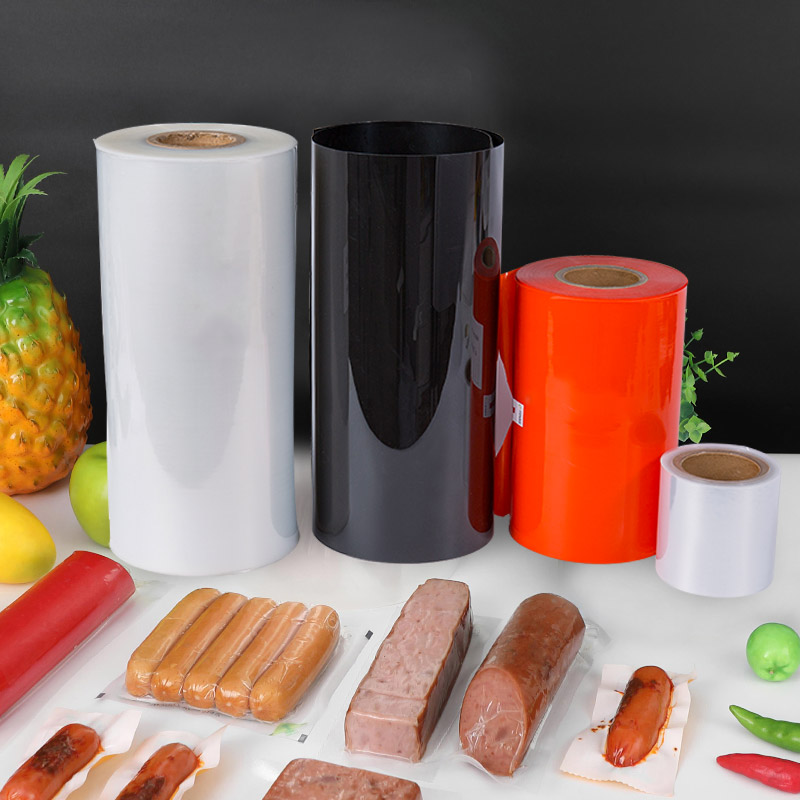
Bottom thermoforming film is the structural base web in a thermoform packaging line — the layer that is heated, drawn down or up into a forming cavity, and shaped into the rigid or semi-rigid tray that holds the product. In a rollstock thermoforming machine, the bottom film unwinds continuously from a supply roll, passes through a heating station that brings the film to its forming temperature, and is then mechanically or pneumatically pressed into mold cavities to create the product pocket. The filled tray then advances to the sealing station where a top lidding film is heat-sealed across the open face, enclosing the product.
The bottom film is the load-bearing component of the final package. It must retain dimensional stability after forming, support the product weight during handling and transit, and maintain seal integrity at the flange where the lidding film bonds to it. These structural demands make bottom film specification considerably more complex than selecting a top lidding film — the material must balance formability, rigidity after cooling, barrier performance, seal compatibility, and, increasingly, sustainability requirements, all within a thickness and cost target set by packaging economics.
Material Composition and Structure
Bottom thermoforming films are almost always multi-layer co-extruded or laminated structures rather than monolayer materials. Each layer contributes a specific functional property, and the overall structure is engineered to deliver a performance profile that no single polymer could achieve alone.
Common Layer Functions
- Structural / bulk layer: Typically polyamide (PA/nylon), polypropylene (PP), or polyethylene terephthalate (PET), providing the mechanical rigidity and thermoformability that gives the tray its shape-holding integrity after forming.
- Barrier layer: Ethylene vinyl alcohol (EVOH) is the most widely used oxygen barrier layer in high-barrier thermoforming films, typically positioned in the center of the structure where it is protected from moisture by adjacent layers. For extreme barrier requirements, metallized layers or PVDC may be incorporated.
- Sealant layer: The innermost layer — the surface that contacts the product and seals to the lidding film — is usually polyethylene (PE) or an ionomer. This layer must be compatible with the top film's sealant layer to form a reliable hermetic bond at the sealing station temperature and dwell time.
- Tie / adhesive layers: Between dissimilar polymers that do not naturally bond, thin tie layers of modified polyolefin adhesives maintain structural cohesion through the forming and sealing process.
Total film thickness for bottom thermoforming webs typically ranges from 100 to 500 microns, depending on the draw depth of the cavity, the rigidity requirement of the finished tray, and the product weight the package must support. Deeper draw ratios — the ratio of cavity depth to cavity width — demand films with higher elongation-at-break values and more uniform thickness distribution after forming to prevent thinning at corners and sidewalls.
Key Performance Parameters for Thermoforming Bottom Film
Specifying a bottom thermoforming film requires evaluating several interdependent performance parameters. Optimizing one in isolation frequently compromises another, which is why film selection is best approached as a system-level decision involving the packaging material, the machine settings, and the end-use performance requirements together.
| Parameter | Why It Matters | Typical Specification |
|---|---|---|
| Forming temperature range | Determines heating station settings and cycle time | 120–180°C depending on polymer |
| Oxygen transmission rate (OTR) | Controls shelf life for oxygen-sensitive products | <1 to <10 cc/m²/day for high-barrier |
| Water vapor transmission rate (WVTR) | Prevents moisture loss or ingress depending on product | Varies widely; <5 g/m²/day common |
| Elongation at break | Determines maximum draw depth without tearing | 200–400% for deep-draw applications |
| Seal strength | Ensures hermetic integrity under transport and handling | ≥15 N/15mm for most food applications |
| Puncture resistance | Critical for bone-in meat and sharp-edged products | Specified in Newtons; PA-containing structures preferred |
Bottom Thermoforming Film by Application: Food, Medical, and Industrial
The material structure of a bottom thermoforming film is driven almost entirely by the end application. A film that performs optimally for fresh red meat packaging is not appropriate for medical device sterile barrier packaging, and vice versa. Understanding the requirements of each application category guides both material selection and machine configuration.
Food Packaging
Food is the dominant application for bottom thermoforming film by volume. Fresh meat, processed meat, cheese, seafood, ready meals, and dairy products are all commonly packaged on rollstock thermoforming lines. For modified atmosphere packaging (MAP) and vacuum skin packaging (VSP) — the two most common formats — the bottom film must provide high oxygen barrier performance to suppress aerobic spoilage, sufficient puncture resistance to withstand bone fragments and sharp edges, and a sealant layer fully compatible with food-contact regulations (EU 10/2011, FDA 21 CFR, or regional equivalents). PA/EVOH/PE and PA/EVOH/PP structures dominate this segment.
Medical and Pharmaceutical Packaging
Medical device thermoforming demands biocompatibility, sterilization compatibility (ETO, gamma, or steam as applicable), and validated seal integrity. Bottom films for medical blister and tray packaging are typically PVC, PETG, or PP-based, selected partly for their compatibility with the sterilization method — PVC, for example, is incompatible with gamma sterilization at higher doses. Regulatory compliance documentation (ISO 11607, USP Class VI, or equivalent) is a non-negotiable deliverable from the film supplier in this segment.
Industrial and Non-Food Applications
Hardware, electronic components, automotive parts, and consumer goods packaged in thermoformed trays place emphasis on dimensional stability, rigidity at ambient and elevated temperatures, and ESD (electrostatic discharge) protection for sensitive components. High-impact polystyrene (HIPS), ABS, and conductive or dissipative PE formulations are commonly specified in this segment, where barrier performance is secondary to mechanical and functional requirements.
Sustainable and Recyclable Bottom Thermoforming Film Options
The multi-layer construction that makes bottom thermoforming film functionally effective has historically made it one of the more challenging flexible packaging formats to recycle. Structures combining PA, EVOH, PE, and tie layers are typically classified as mixed plastics and are not accepted in most curbside recycling streams. This is a recognized pressure point across the food and consumer goods industries, and film suppliers have responded with several structural approaches aimed at maintaining performance while improving end-of-life options.
- Mono-material PE structures: All-polyethylene bottom films — using high-barrier PE grades and EVOH incorporated within a predominantly PE structure — are designed to be compatible with PE film recycling streams. Achieving the barrier performance of PA-based structures in mono-PE requires careful layer engineering and is an active area of development, with several commercial solutions now available for moderate-barrier applications.
- Mono-material PP structures: Similar logic applied to polypropylene, targeting compatibility with PP recycling infrastructure. PP-based thermoforming films also benefit from PP's higher temperature resistance, making them suitable for hot-fill and retort applications where PE structures are not.
- Reduced-thickness / downgauged structures: Maintaining the same performance specifications at lower total film thickness reduces material consumption and weight per package without changing the polymer system. Advances in co-extrusion precision and layer optimization have enabled meaningful thickness reductions — in some cases 15–25% — in commercially deployed bottom films over the past decade.
- Bio-based polymers: PLA (polylactic acid) and bio-based PE are being evaluated as components in thermoforming film structures for applications where the compostability or renewable feedstock content of the film is a commercial priority, though performance parity with petrochemical-based structures in high-barrier applications remains an ongoing technical challenge.
Machine Compatibility and Processing Considerations
Bottom thermoforming film performance on a packaging line is inseparable from the machine settings it runs on. The same film structure can produce flawless trays on a well-calibrated machine and consistent defects on a machine with heating zone imbalances or worn forming tooling. Several processing parameters deserve attention when introducing a new bottom film to an existing line or commissioning a new installation.
Web tension through the forming station affects film draw uniformity. Too little tension allows the film to sag and form unevenly; too much tension pre-stresses the film before the heating zone and can cause tearing at cavity edges during forming. Web tension specifications should be provided by the film supplier and validated during line trials before full production. Heating zone profiling — the ability to set different temperatures across the width and length of the heating platen — is particularly important for wider-web machines running structured films, where differential thermal conductivity between layers can create hot spots if the heating profile is not matched to the film's construction.
Roll geometry is the final practical consideration. Bottom film rolls are typically supplied as pancake rolls (flat-wound on a core) rather than traverse-wound, because the film must track precisely through the forming tool index-to-index. Core diameter, outer roll diameter, and roll weight must fall within the unwind station's specifications — oversized or undersized rolls cause tension fluctuations that translate directly into forming inconsistency and increased scrap rates at the start and end of every roll.