 EN
EN
 English
 日本語
日本語 Español
 Deutsch
 عربى
عربى
Content
- 1 Coffee Packaging Bags: Why the Right Format Protects Quality and Sells Product
- 2 The Materials That Make a Coffee Packaging Bag Work
- 3 Stand Up Pouch for Coffee
- 4 Flat Bottom Pouch for Coffee
- 5 Other Coffee Packaging Bag Formats
- 6 Sustainability in Coffee Packaging Bags
- 7 Specification Guide: Choosing the Right Coffee Packaging Bag
Coffee Packaging Bags: Why the Right Format Protects Quality and Sells Product
Coffee is one of the most demanding products to package well. Freshly roasted coffee releases carbon dioxide continuously for days after roasting -- a process called degassing -- which means the packaging must vent CO2 outward while preventing oxygen from entering. Oxygen, moisture, UV light, and volatile aromatic compounds escaping from the coffee are the four primary degradation pathways, and each must be managed by the bag structure to preserve the flavor, aroma, and freshness that defines premium coffee.
A coffee packaging bag is not simply a container -- it is an active preservation system whose barrier properties, valve technology, closure design, and structural format collectively determine how long the coffee inside remains at peak quality after roasting and how effectively it communicates brand values at retail. The format of the bag -- whether a stand up pouch, a flat bottom pouch, a side gusset bag, or a valve-equipped flat pillow -- also shapes the retail display, storage efficiency, and consumer experience from the moment the bag is lifted from the shelf to the last scoop taken from the package.
The two dominant premium formats in the specialty coffee market today are the stand up pouch and the flat bottom pouch, and understanding what distinguishes them -- in structure, performance, and market positioning -- is the starting point for any coffee brand making packaging decisions.
The Materials That Make a Coffee Packaging Bag Work
Before examining specific bag formats, the material structure of the coffee packaging bag itself requires attention. The barrier performance -- the ability to exclude oxygen, moisture, and light from the coffee -- is determined by the laminate construction of the bag material, not by the bag format. The same barrier laminate can be formed into a stand up pouch, a flat bottom pouch, or any other format, and the barrier performance remains consistent across formats for the same material specification.
Typical Coffee Bag Laminate Structures
A coffee packaging bag is typically a multilayer laminate bonded by adhesive lamination or extrusion lamination. Each layer contributes specific functional properties:
- Outer layer (typically BOPP, PET, or kraft paper): The printable surface layer that carries the brand graphics, product information, and surface finish (matte, gloss, soft-touch). Biaxially oriented polypropylene (BOPP) and polyester (PET) are the standard outer layers for fully printed film pouches. Kraft paper outer layers are used for natural aesthetic packaging positioned on sustainability credentials.
- Barrier layer (aluminum foil, metallized PET, or EVOH): The primary oxygen and moisture barrier. Aluminum foil provides the highest barrier performance -- oxygen transmission rate (OTR) below 0.001 cc/m2/day -- and is opaque to light. Metallized PET provides a good barrier with some light opacity at lower cost than foil. Ethylene vinyl alcohol (EVOH) is a transparent barrier option used in clear-window pouches where the coffee is visible through the bag wall.
- Inner heat-seal layer (CPP or LLDPE): The food-contact layer that also provides the heat-sealable surface for forming the bag seams and the top seal after filling. Cast polypropylene (CPP) and linear low-density polyethylene (LLDPE) are the standard sealant layer materials. The sealant layer must be chemically inert in contact with coffee, seal reliably over a range of temperatures and pressures on filling lines, and provide adequate seal strength to withstand the internal pressure from coffee degassing.
One-Way Degassing Valve
The one-way degassing valve is the critical component that enables freshly roasted coffee to be packaged immediately after roasting without waiting for degassing to complete. The valve -- a small pressure-relief device heat-sealed into a hole in the bag wall -- allows CO2 generated by the roasted coffee to escape continuously while a silicone oil or elastomeric membrane in the valve prevents outside air from entering through the valve in the reverse direction. Without a degassing valve, a bag sealed immediately after roasting would burst from the internal CO2 pressure within hours. With the valve, the bag can be filled, sealed, and shipped within hours of roasting -- preserving maximum freshness.
Valve specifications to verify when selecting coffee packaging include the cracking pressure (the internal pressure at which the valve opens to release CO2), the back-pressure resistance (the external pressure the valve resists without allowing air ingress), and the valve leak test compliance with industry standards. Premium coffee packaging specifications commonly require valves that pass 100% in-line leak detection during bag production, with valve inspection integrated into the bag manufacturing process rather than performed as a separate quality step.
Closure and Resealability
Resealable closure systems preserve coffee quality between uses. Zip-lock (zipper closure) strips heat-sealed across the top of the bag interior are the standard resealable feature for consumer coffee packaging. The zipper must provide an airtight closure that the consumer can reliably engage and disengage repeatedly, and its placement relative to the bag top edge and the fill line must allow adequate headspace above the coffee surface for the zipper to function without being obstructed by the product. Tin ties -- metal-strip fold closures crimped to the top of the bag -- are an alternative resealable feature used on some premium and specialty coffee bag formats.
Stand Up Pouch for Coffee
The stand up pouch -- also called a doypack or stand up bag -- is a flexible packaging format with a bottom gusset that unfolds when the bag is filled, creating a stable base that allows the pouch to stand upright on a flat surface. The Doyen patent that originated this format in the 1960s has long expired, and stand up pouches are now one of the most widely produced flexible packaging formats globally, with coffee packaging as one of their primary applications.
Structural Construction of the Stand Up Pouch
A stand up pouch consists of two flat side panels and a bottom gusset panel, heat-sealed together along the side edges and the curved bottom edges. The bottom gusset is typically a folded W-shape when flat, which unfolds to form the curved base structure when the pouch is filled and pressurized. The side seals run from the top of the pouch to the base of the curved bottom, and the design of the bottom seal geometry -- the radius of the curve and the angle of the side seals -- determines how stably the filled pouch stands and how its silhouette looks on shelf.
The front panel of a stand up pouch is the primary retail display surface, and its printable area extends from near the bottom gusset to the resealable zipper or tear-notch at the top, providing a large, flat, fully printable rectangle that is highly visible on a retail shelf when the bag stands upright. The back panel carries secondary product information, nutritional data, barcode, and regulatory compliance text. The gusset panel, when visible at the bottom, may carry additional branding or remain plain.
Advantages of the Stand Up Pouch for Coffee Packaging
- Established retail presence: The stand up pouch is the most recognized format in specialty coffee retail. Consumers are familiar with it, and its upright orientation at the point of sale creates a consistent, professional shelf appearance that communicates premium product positioning effectively.
- Cost efficiency: The stand up pouch is produced at high speed on standard form-fill-seal (FFS) equipment and is available in a wide range of sizes and specifications from many suppliers globally. The competitive supply base and established manufacturing infrastructure make it one of the most cost-effective premium flexible coffee packaging formats.
- Wide size range: Stand up pouches for coffee are produced in sizes from 100g to 2kg and above, covering the full range of retail weight formats from single-serve to foodservice quantities in a single bag format.
- Design flexibility: The large flat front panel accommodates complex, high-resolution print designs including photographic imagery, detailed illustration, and precise color matching for brand consistency across a range from simple one-color designs to nine-color extended gamut printing.
- Lightweight and efficient shipping: Stand up pouches have a favorable product-to-package weight ratio and compact flat format before filling, reducing shipping and storage costs for both the empty bags and the filled retail units.
Limitations of the Stand Up Pouch
The stand up pouch's curved bottom gusset limits its stability when filled with heavy or coarse ground coffee -- the rounded base can cause the bag to tip if not fully filled. The curved bottom and tapered silhouette also mean that when the bag is placed on a flat surface, the front panel leans slightly backward, reducing the visual impact of the brand graphics compared to a bag with a perfectly flat base. At retail, shelf space utilization is less efficient with rounded-bottom stand up pouches than with flat-bottom formats, as the curved base creates wasted space between adjacent bags.
Flat Bottom Pouch for Coffee
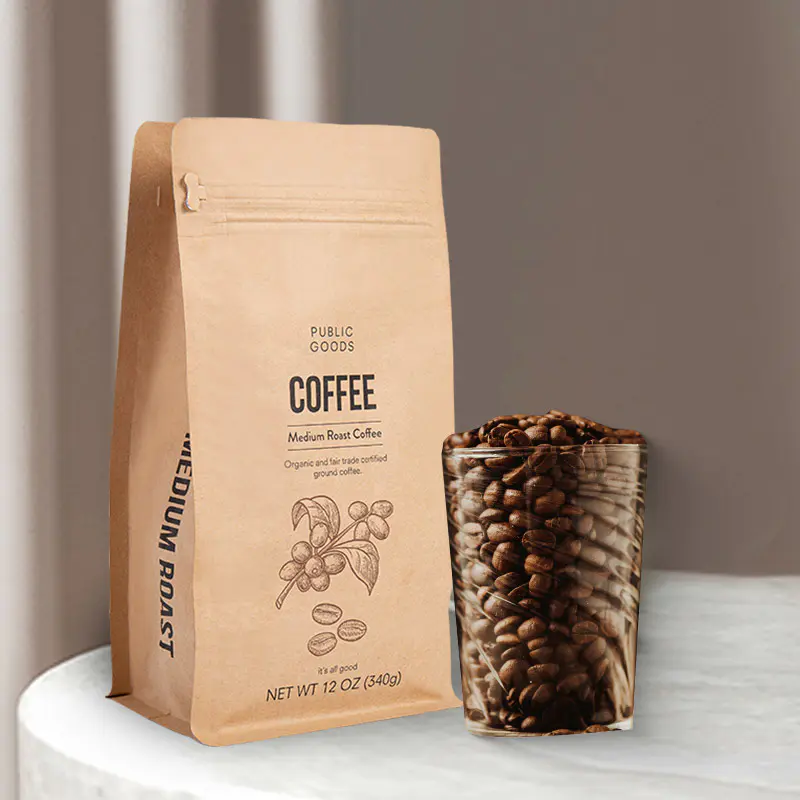
The flat bottom pouch -- also called a box pouch, block bottom pouch, or Stabilo pouch -- is a more recent flexible packaging format that addresses the stability and shelf presence limitations of the curved-bottom stand up pouch by incorporating a true flat, rectangular base. The result is a bag that stands completely upright with a perfectly vertical front panel, has four distinct printable surfaces (front, back, left side panel, and right side panel), and presents a box-like silhouette that more closely resembles a rigid carton than a flexible pouch.
Structural Construction of the Flat Bottom Pouch
The flat bottom pouch is structurally more complex than the stand up pouch. It consists of a front panel, a back panel, two side gusset panels, and a bottom panel -- five panel surfaces compared to the stand up pouch's three. The bottom panel is a separate flat piece of material heat-sealed to the base of all four side panels, forming a rigid rectangular footprint when the bag is filled and sealed. The construction creates four distinct printable side panels in addition to the flat bottom, giving the flat bottom pouch a total of five display surfaces.
The flat rectangular base of the flat bottom pouch is its defining feature. When the bag stands on a shelf, it presents a perfectly vertical front panel with 100% upright orientation, eliminating the slight backward lean of a round-bottom stand up pouch. Adjacent flat bottom pouches pack tightly against each other on the shelf, with no wasted space from curved base geometry, maximizing the number of units per shelf linear meter.
Advantages of the Flat Bottom Pouch for Coffee Packaging
- Superior shelf presence and stability: The flat base and vertical front panel create a shelf appearance that rivals a rigid carton in visual impact. The bag stands firmly without leaning or tipping, maintains its upright position when the consumer handles adjacent bags, and presents the full design area of the front panel in a perfectly vertical plane for maximum visual communication.
- Five printable surfaces: Front, back, left side, right side, and bottom panels all provide printable real estate. For coffee brands with complex product ranges, the additional side panels allow different product information, origin stories, brewing guides, and QR codes to be positioned on surfaces that the consumer naturally examines when picking up the bag -- the sides are at eye level and at hand level in a way that the back panel of a standing pouch rarely is.
- Premium market positioning: The flat bottom pouch is widely recognized as the premium flexible coffee packaging format, associated with specialty coffee roasters and high-end retail positioning. Its box-like structure communicates a quality and care signal that the rounded-bottom stand up pouch -- despite equivalent barrier performance -- does not achieve as effectively for the premium segment.
- Efficient shelf space utilization: The rectangular footprint allows flat bottom pouches to be packed closely together on shelf, improving the number of facings per unit of shelf space and reducing the air gap wasted between rounded-base alternatives.
- Excellent for gift and specialty retail: The box-like form factor of the flat bottom pouch is particularly effective in gift retail, specialty food stores, and direct-to-consumer subscription boxes where the unboxing experience and the visual presentation of the product on a recipient's kitchen counter carry significant brand value.
Limitations of the Flat Bottom Pouch
The flat bottom pouch is more expensive to produce than the stand up pouch, both in material cost (the additional side and bottom panels increase material use per bag) and in manufacturing complexity (forming the flat bottom requires specialized filling and sealing equipment, and production speeds are generally lower than for standard stand up pouches on conventional FFS equipment). Minimum order quantities from flexible packaging suppliers for flat bottom pouches are typically higher than for stand up pouches because of the tooling investment required for the format.
The flat bottom pouch also requires more precise filling parameters: if underfilled, the bag does not achieve its full rectangular silhouette and the side panels collapse inward, undermining the box-like appearance. A consistent fill weight and appropriate headspace are more critical to the finished appearance of a flat bottom pouch than a stand up pouch, where some variation in fill level has less visual impact on the overall bag shape.
| Feature | Stand Up Pouch | Flat Bottom Pouch |
|---|---|---|
| Base geometry | Curved W-gusset bottom | Flat rectangular base panel |
| Number of printable panels | 2 (front and back, gusset limited) | 5 (front, back, two sides, bottom) |
| Upright stability | Good when well-filled | Excellent, fully upright |
| Front panel display angle | Slight backward lean | Perfectly vertical |
| Shelf space efficiency | Moderate | High (rectangular packing) |
| Unit material cost | Lower | Higher |
| Minimum order quantity | Lower (widely available) | Higher (specialized tooling) |
| Market positioning | Specialty to premium | Premium to ultra-premium |
| Filling equipment complexity | Standard FFS equipment | Specialized flat-bottom filling line |
Other Coffee Packaging Bag Formats
While the stand up pouch and flat bottom pouch dominate the premium specialty coffee retail segment, other coffee packaging bag formats serve specific volume, channel, or price point requirements that these two formats do not address as effectively.
Side Gusset Bag
The side gusset bag is a flat-front, flat-back pouch with expandable side gussets that accordion outward as the bag fills. When sealed, it presents two wide flat panels (front and back) with gusseted sides that accommodate volume without distorting the flat panel shape. Side gusset bags are widely used for 500g and 1kg coffee at wholesale and private label retail, where the large flat panels provide excellent print area and the bag can be produced at high speed on standard equipment. The side gusset format does not stand up independently as reliably as a stand up or flat bottom pouch without a gusset bottom, so it is more commonly seen displayed hanging on hooks or laid flat in retail environments.
Quad Seal Bag
The quad seal bag has four vertical side seams (two on each side) in addition to a flat bottom and top, creating a more structured, nearly rectangular profile when filled. It stands upright well, has a large printable area on all four faces, and can accommodate a wide range of fill volumes. The quad seal bag is increasingly used in premium coffee and specialty food packaging as an alternative to the flat bottom pouch, with a slightly different aesthetic that some brands find better matches their visual identity. Its production is more similar to standard side gusset bag manufacturing than to the specialized flat bottom format, which can make it more accessible for medium-volume runs.
Valve-Equipped Flat Pillow Pouch
The flat pillow pouch -- a simple three-seal pouch (two end seals and one back seam) with a one-way degassing valve -- is used for lower-cost coffee packaging at commodity price points and for capsule and pod-compatible coffee formats. It does not stand upright, does not provide the shelf presence of a stand up or flat bottom format, and is not resealable without an additional feature. It is the most cost-effective flexible coffee packaging format for high-volume, lower-margin segments and for coffee that is sold through channels where shelf display is not the primary purchase driver, such as online subscription boxes or foodservice.
Sustainability in Coffee Packaging Bags
The coffee packaging industry is under significant pressure from brands, retailers, and consumers to reduce the environmental impact of flexible packaging. The multilayer laminate constructions that provide excellent barrier performance for coffee are inherently difficult to recycle through mainstream waste streams because the layers of different polymers (or polymer plus foil) cannot be separated economically in standard sorting and recycling facilities.
Three main approaches are being adopted in the industry to address this challenge: mono-material recyclable structures, compostable packaging, and specialist recycling programs.
Mono-Material Recyclable Structures
Mono-material coffee bags are made from a single polymer family -- typically all-polyethylene (PE) or all-polypropylene (PP) laminates -- so that the entire bag can be recycled in the appropriate stream (soft plastics recycling for PE, or through specialist collection programs) without separation. Achieving adequate oxygen barrier performance in a mono-material polyolefin structure requires the incorporation of barrier layers of EVOH or the use of vacuum deposited oxide coatings on the film, but several suppliers now offer mono-material coffee bag laminates that meet the barrier requirements for standard shelf life expectations. Performance in hot or high-humidity environments may be more limited than foil-laminate alternatives, but for many specialty coffee brands and markets, the recyclability benefit justifies any performance trade-off.
Compostable Coffee Packaging
Compostable coffee bags are designed to break down in industrial composting facilities (or in some cases in home compost conditions) within defined timeframes and without leaving persistent plastic fragments. They are certified to EN 13432 (industrial compostable) or AS 5810 (home compostable) standards, which require verification of the disintegration rate, biodegradation, eco-toxicity, and heavy metal content of the packaging and any degradation products. Compostable bags for coffee present a challenge in barrier performance -- the bio-based and compostable polymers available currently do not match the oxygen barrier of aluminum foil -- and are most suitable for specialty coffee with shorter retail shelf life expectations or for brands whose customers have access to industrial composting infrastructure.
Specialist Recycling and Take-Back Programs
Some coffee brands partner with specialist soft plastics recycling programs or operate their own pouch take-back schemes, allowing consumers to return used coffee bags for specialist recycling outside the standard curbside stream. While this approach does not require a change in bag material -- the same foil-laminate bag with excellent barrier performance can be used -- its environmental impact is limited by consumer participation rates and the logistics of collecting and transporting used packaging to specialist recyclers.
Specification Guide: Choosing the Right Coffee Packaging Bag
For coffee roasters, brand owners, and buyers specifying coffee packaging, the following framework covers the key decisions that determine which bag format and specification best serves the product, the brand, and the commercial context.
Product and Retail Channel Fit
The format choice should follow from the retail channel and consumer segment. Specialty coffee at independent coffee shops, premium grocery, and online subscription is well-served by the flat bottom pouch for maximum shelf presence and premium positioning. Specialty coffee at wider retail distribution with higher volume requirements is well-served by the stand up pouch, which offers equivalent barrier performance at lower cost and more flexible minimum order quantities. Wholesale and foodservice coffee in 1kg to 5kg formats typically uses side gusset bags. The flat pillow pouch suits online-only brands where retail shelf display is not a factor.
Shelf Life and Barrier Requirement
A 12-month shelf life target for specialty roasted coffee requires a high-barrier laminate with an aluminum foil or high-barrier metallized barrier layer and an oxygen transmission rate below 0.5 cc/m2/day. A 6-month shelf life in a controlled environment may be achievable with a lower-barrier metallized or EVOH structure at lower cost. The barrier requirement must be confirmed by accelerated shelf life testing of the actual coffee in the proposed packaging before committing to a laminate specification, as the interaction between roast level, grind size, fill weight, and headspace gas flushing significantly affects the rate of staling.
Minimum Order Quantity and Lead Time
For small-batch roasters and early-stage brands, minimum order quantities (MOQs) are often the binding constraint in packaging selection. Stand up pouches are available from many digital and short-run print suppliers in quantities as low as 500 to 1,000 units, with high-quality digital printing accommodating multiple SKUs at low volume. Flat bottom pouches typically require gravure or flexographic printing at MOQs of 5,000 to 20,000 units per SKU and above, which represents a significant minimum inventory investment. A roaster transitioning from startup to established brand may move from digital-printed stand up pouches to flexographic flat bottom pouches as volume justifies the format upgrade.
Print Technology and Design Fidelity
The print technology used for the coffee bag determines the achievable design quality, color accuracy, and minimum order economically viable. Digital printing (HP Indigo or comparable) supports low MOQs, variable data (batch codes, origin stories, personalized labels), and a wide color gamut with consistent color from unit to unit. Flexographic printing at medium to high volume achieves excellent color saturation and line quality at lower cost per unit than digital, but requires print plates (tooling cost) and minimum run lengths that are uneconomical at low volume. Gravure printing at very high volume achieves the highest print quality and consistency, particularly for photographic imagery and fine detail, but requires the highest tooling investment (engraved cylinders) and the longest runs to amortize that cost effectively.