 EN
EN
 English
 日本語
日本語 Español
 Deutsch
 عربى
عربى
Content
- 1 From −45°C Frozen to 121°C Retort: Choosing the Right Multi-layer Co-extruded Film
- 2 Layer Architecture: How 7, 9, and 11 Layers Unlock Barrier Performance
- 3 High Barrier Thermoforming Film: Design for Forming, Sealing, and Shelf Life
- 4 Low-Temperature Frozen Film: Maintaining Integrity from −18°C to −45°C
- 5 High-Temperature Cooking Film: Retort Performance at 121°C
- 6 Film Specification Comparison Across Frozen, Chilled, and Retort Applications
From −45°C Frozen to 121°C Retort: Choosing the Right Multi-layer Co-extruded Film
Food processors operating across frozen protein, chilled deli, and heat-processed ready-to-eat product lines face a common challenge: no single conventional packaging film delivers the combination of low-temperature flexibility, oxygen barrier performance, puncture resistance, and retort stability that modern food supply chains demand simultaneously. Multi-layer co-extruded film resolves this by engineering each functional requirement into a dedicated layer within a unified film structure, producing a material whose total performance far exceeds what any individual polymer can achieve alone.
Unlike adhesive lamination — where separately manufactured films are bonded with solvent- or water-based adhesive systems that introduce delamination risk under thermal and mechanical stress — co-extrusion fuses multiple molten polymer streams through a single multi-channel die in a single continuous process step. The resulting film has no adhesive interfaces to fail, no solvent residue to migrate into food contact surfaces, and no discrete bonding step that constrains layer thickness ratios. Advanced production lines running seven-layer, nine-layer, and eleven-layer co-extruded structures represent the current performance ceiling in flexible food packaging film technology, delivering barrier properties and mechanical characteristics that lower-layer-count films simply cannot replicate.
This article examines how multi-layer co-extruded film is constructed, what differentiates frozen-grade from retort-grade barrier films, and how food packaging engineers can match film specifications to the specific thermal, mechanical, and shelf-life requirements of their product categories — from frozen pork and seafood to pressure-cooked cooked meat products.
Layer Architecture: How 7, 9, and 11 Layers Unlock Barrier Performance
The performance advantage of high-layer-count co-extruded films is not simply additive — it is architectural. Each additional layer provides an opportunity to position a specific polymer at the location within the film cross-section where it delivers maximum functional benefit, while surrounding layers protect it from the environmental and processing conditions that would otherwise degrade its performance.
Core Barrier System: EVOH Placement and Protection
Ethylene vinyl alcohol (EVOH) is the dominant oxygen barrier resin in multi-layer co-extruded food packaging film, capable of achieving oxygen transmission rates below 0.5 cc/m²/day/atm at low ethylene content grades — performance that no polyolefin or polyester film can approach. However, EVOH is highly sensitive to moisture: as water absorption increases, its crystalline barrier structure disrupts and oxygen transmission rises sharply. In a nine-layer or eleven-layer co-extruded structure, the EVOH barrier layer is positioned at the center of the film cross-section and flanked on both sides by polyamide (PA) layers that absorb ambient moisture before it can reach the EVOH core. Tie resin layers on either side of the EVOH create molecular adhesion bridges to the adjacent polyamide, while outer polyolefin layers provide the sealing and structural properties required at the film surfaces. This architecture maintains EVOH in a low-moisture environment throughout product storage, preserving barrier performance over the entire intended shelf life.
Puncture Resistance Through Layer Synergy
Puncture resistance in multi-layer co-extruded film emerges from the interaction between layers of differing stiffness and ductility rather than from any single layer's individual puncture strength. When a bone fragment, shell edge, or processing equipment contact point initiates a crack in a hard outer layer, the adjacent soft and ductile layer absorbs the propagating crack energy and arrests penetration before it reaches the barrier core. Seven-layer and higher structures can alternate hard polyamide with soft metallocene polyethylene layers in a deliberate crack-arrest stack, achieving puncture resistance values per unit thickness that exceed monolayer or three-layer films of equivalent gauge by 40–60% in standardized puncture probe testing. This allows thinner overall film construction to protect frozen beef, lamb, pork, fish, shrimp, and seafood with equivalent or superior physical protection versus heavier conventional films.
High Barrier Thermoforming Film: Design for Forming, Sealing, and Shelf Life
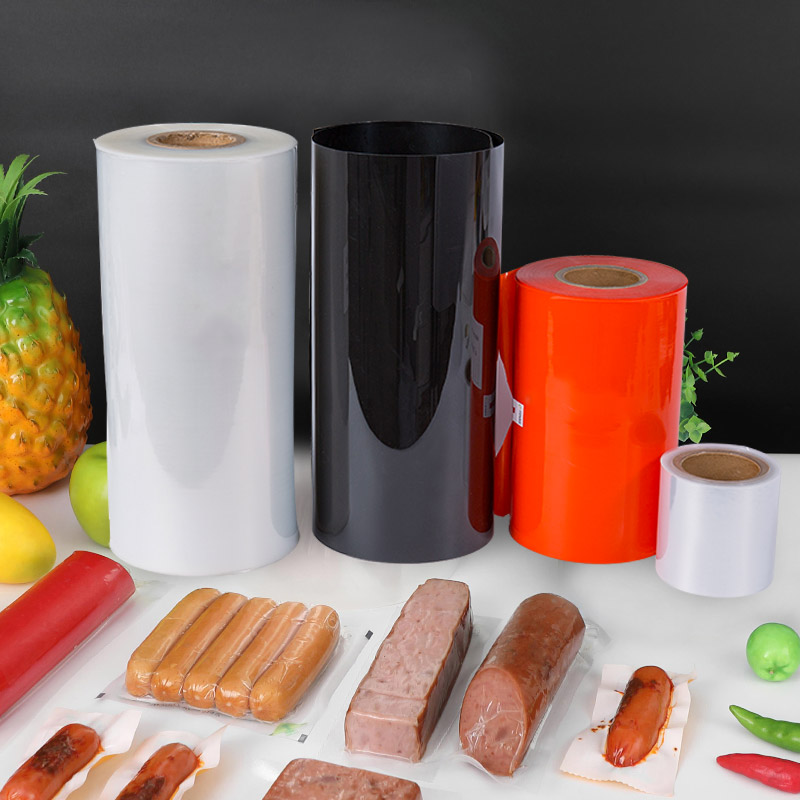
High barrier thermoforming film with excellent barrier function addresses one of the most technically demanding applications in flexible packaging: the bottom web of a thermoforming packaging machine, where the film must transition from a flat roll stock to a three-dimensional formed tray within seconds, then maintain full barrier performance throughout the product's distribution life.
Thermoforming imposes severe mechanical demands on the film structure. As the heated film draws into the mold cavity under vacuum or compressed air, material thins at corners and edges where draw ratios reach 2:1 to 4:1 depending on tray depth and geometry. In a poorly designed barrier film, this thinning concentrates in the EVOH barrier layer — precisely where it is most critical — reducing barrier thickness at package corners to a fraction of the nominal specification and creating localized oxygen ingress pathways that compromise the entire package's shelf life performance. High barrier thermoforming film with excellent barrier function prevents this through careful EVOH grade selection (higher ethylene content improves thermoformability at the cost of modest barrier reduction, a trade-off optimized for the specific draw ratio requirement), strategic positioning of the barrier layer at the film's neutral bending axis, and use of polyamide structural layers that distribute forming stress more uniformly than polyolefin alternatives.
The commercial impact of correctly specified high barrier thermoforming film is measurable in shelf life extension directly attributable to oxygen exclusion. Fresh red meat packaged under vacuum in a properly specified barrier thermoform maintains acceptable color, microbiological safety, and flavor significantly longer than product packaged in standard non-barrier film — a difference that reduces retail markdown rates, consumer waste, and supply chain losses in proportion to the improvement in barrier performance.
Low-Temperature Frozen Film: Maintaining Integrity from −18°C to −45°C
Frozen food packaging exposes film to physical and chemical stresses that differ fundamentally from ambient or chilled applications. At storage temperatures between −18°C and −45°C, most standard polymer films undergo embrittlement as molecular chain mobility decreases below the polymer's glass transition temperature. Films that flex adequately at room temperature may crack, pinhole, or delaminate at layer interfaces when subjected to the impact and flexural stresses of frozen product handling — palletizing, depalletizing, case packing, and consumer handling in retail freezer environments.
Low-temperature frozen multi-layer co-extruded film addresses this through targeted resin selection throughout the layer stack. Metallocene-catalyzed linear low-density polyethylene (mLLDPE) — produced with single-site catalyst technology that creates a narrow molecular weight distribution and highly uniform comonomer incorporation — maintains film ductility and impact resistance at temperatures as low as −45°C where conventional Ziegler-Natta LLDPE grades show significant brittleness. Specific polyamide grades with low glass transition temperatures are specified for structural layers to maintain flexibility and layer adhesion through the full frozen temperature range. Heat seal layers are formulated to retain peel strength at frozen temperatures, preventing package seal failure during the mechanical impacts of frozen logistics.
This frozen film category covers the full range of frozen protein categories where barrier packaging delivers commercial value: pork, beef, and lamb benefit from oxygen barrier that prevents myoglobin oxidation and surface browning during frozen storage; chicken, duck, and goose require moisture vapor barrier to prevent freezer burn dehydration; fish, shrimp, and seafood demand both oxygen and moisture control alongside the mechanical protection that resists damage from the irregular sharp geometries of frozen seafood pieces.
High-Temperature Cooking Film: Retort Performance at 121°C
High-temperature vacuum cooking barrier film represents the most demanding thermal performance requirement in the multi-layer co-extruded film product range. Retort sterilization at 121°C subjects the complete sealed package — film, product, and seal — to simultaneous thermal stress, elevated hydrostatic pressure, and hot water or steam contact for process cycles typically lasting 20 to 60 minutes. Every polymer layer in the film structure must maintain its mechanical properties, barrier function, and interlayer adhesion throughout this process and then continue protecting the product during ambient or chilled distribution that may extend for months.
Achieving validated retort performance requires fundamental changes to the resin selection logic used in frozen or chilled barrier film design. The sealing layer must transition from polyethylene — which softens above 110°C and cannot maintain seal integrity through retort — to cast polypropylene (CPP) or retort-grade polypropylene copolymer with a melting point above 140°C and sufficient heat seal strength at retort temperature to contain the internal pressure generated by product moisture vaporization. EVOH barrier grades with higher ethylene content (38–44 mol%) are specified for retort applications because they maintain adequate melt processability during co-extrusion and demonstrate better post-retort barrier recovery than low-ethylene grades. Polyamide structural layers must be specified to grades that resist hydrolytic degradation at 121°C, where standard PA6 absorbs significant moisture and loses tensile strength through chain scission.
The practical application of high-temperature cooking film centers on the cooked and shelf-stable meat product sector. Vacuum-sealed cooked chicken, duck, goose, and pig's feet are packaged in retort-capable multi-layer co-extruded film, evacuated to remove residual oxygen, sealed, and then processed through the retort as a complete hermetic unit. The film must survive this sterilization process intact and then deliver barrier protection that maintains product safety and flavor — preserving the unique flavors of food without refrigeration — throughout the product's target shelf life at ambient distribution temperature.
Film Specification Comparison Across Frozen, Chilled, and Retort Applications
Selecting the correct multi-layer co-extruded film for a given application requires systematically matching film properties to the processing conditions, distribution environment, and shelf life target. The table below provides a direct comparison of key specification parameters across the three primary application categories to support engineering and procurement decisions:
| Specification Parameter | Low-Temp Frozen Film (−18°C to −45°C) | High Barrier Thermoforming Film | High-Temp Cooking Film (121°C) |
|---|---|---|---|
| Sealing Layer | Metallocene LLDPE | LLDPE / EVA | Retort-grade CPP |
| Barrier Layer | EVOH / PVDC | Standard EVOH | High-ethylene EVOH (38–44 mol%) |
| O₂ Transmission Rate | <3 cc/m²/day | <1 cc/m²/day | <1 cc/m²/day (post-retort) |
| Key Structural Layer | Low-Tg PA / mLLDPE | PA (uniform draw stress) | Hydrolysis-resistant PA |
| Primary Design Challenge | Low-temp flex and seal retention | Barrier uniformity after forming | Seal and barrier integrity through retort |
| Typical Food Products | Frozen pork, beef, lamb, fish, shrimp, seafood | Fresh meat, vacuum-packed protein | Cooked chicken, duck, goose, pig's feet |
Film thickness customization is a practical necessity across all three categories. Various thicknesses are available to match the specific mechanical protection requirements, forming depth targets, and packaging line runnability constraints of each application — from lightweight 60–80 µm structures for chilled protein vacuum packaging to heavy 200+ µm gauges for deep-draw frozen meat thermoforming where puncture resistance and forming depth simultaneously demand higher gauge. Specifying the correct thickness in combination with the correct layer architecture and resin system is the complete engineering task that determines whether a multi-layer co-extruded film delivers its designed shelf life extension and food quality preservation outcomes in production use.