 EN
EN
 English
 日本語
日本語 Español
 Deutsch
 عربى
عربى
A converter running 250 g coffee pouches at 60 packs per minute once called us with a problem that made no sense on paper: the same film ran cleanly on Monday and jammed the vertical form-fill-seal machine on Wednesday. Nothing in the laminate had changed. The coefficient of friction had.
The short answer: for film running on automatic packaging equipment, target a kinetic coefficient of friction of roughly 0.20 to 0.35 film-to-film, measured to ASTM D1894 or ISO 8295 with a 200 g sled after conditioning. Below about 0.15, rolls telescope and stacked pouches slide; above about 0.45, film drags on the forming collar, stretches and mis-tracks.
That window is a starting point, not a universal law. COF depends on which two surfaces touch, sliding speed, temperature, humidity, corona treatment and how much slip additive has migrated to the surface.
The rest of this page explains where those numbers come from, which variables quietly move them after the lab report is signed, and how to write a COF specification that survives a production trial.
Content
- 1 What the Coefficient of Friction of Plastic Film Actually Measures
- 2 Typical COF Ranges by Film Structure
- 3 Hidden Variables: What COF Does in the Thirty Days After the Lab Report
- 4 Where COF Matters Most: Application Distribution
- 5 Specifying COF: A Six-Step Qualification Workflow
- 6 Storage, Maintenance and Compliance Notes
What the Coefficient of Friction of Plastic Film Actually Measures
COF is a dimensionless ratio: the force needed to start or sustain sliding divided by the normal force pressing the two surfaces together. It is not a fixed material property like density. It is a property of a pair of surfaces under a given set of conditions.
Static COF
The force required to break the film loose from rest. It controls whether a pouch starts moving at all on a conveyor or a sealing jaw.
Kinetic COF
The force required to keep it sliding. Kinetic COF is normally 10 to 25 percent lower than static COF; the gap between the two is what produces stick-slip chatter.
Film-to-film vs film-to-metal
The sealant face against itself governs unwinding and pouch-to-pouch stacking. The outer face against stainless steel governs the forming collar and guides. Report both.
Test methods
ASTM D1894, ISO 8295 and JIS K 7312 all use a weighted sled on a horizontal plane. Sled mass is typically 200 g; sliding speeds differ (about 150 mm/min and 100 mm/min).
What moves the reading on the same roll of film:
- Slip additive type and concentration (erucamide, oleamide, stearates), measured in ppm.
- Which layer carries the additive: buried in the core, or bloomed onto the sealant surface.
- Corona treatment level, which raises surface energy and tends to raise COF.
- Ambient temperature and relative humidity, especially for nylon and for films stored in a warm warehouse.
- Contact pressure and dwell time on the roll, which encourages blocking before a test even begins.
Multi-layer structures give you a lever here: slip can be concentrated in one layer rather than spread through a whole laminate. Our guide to multilayer coextruded film covers how layer order and resin choice interact with surface performance.
 High Barrier EVOH Thermoforming Film for Meat PackagingThis multilayer EVOH film supports barrier protection for sausages and fresh cuts, giving a useful reference when checking supplier quotations against incoming inspection.View Product →
Typical COF Ranges by Film Structure
The figures below are the ranges we see quoted by film suppliers and confirmed in incoming inspection. Treat them as a sanity check on a quotation, not as a substitute for testing your own structure at your own line temperature.
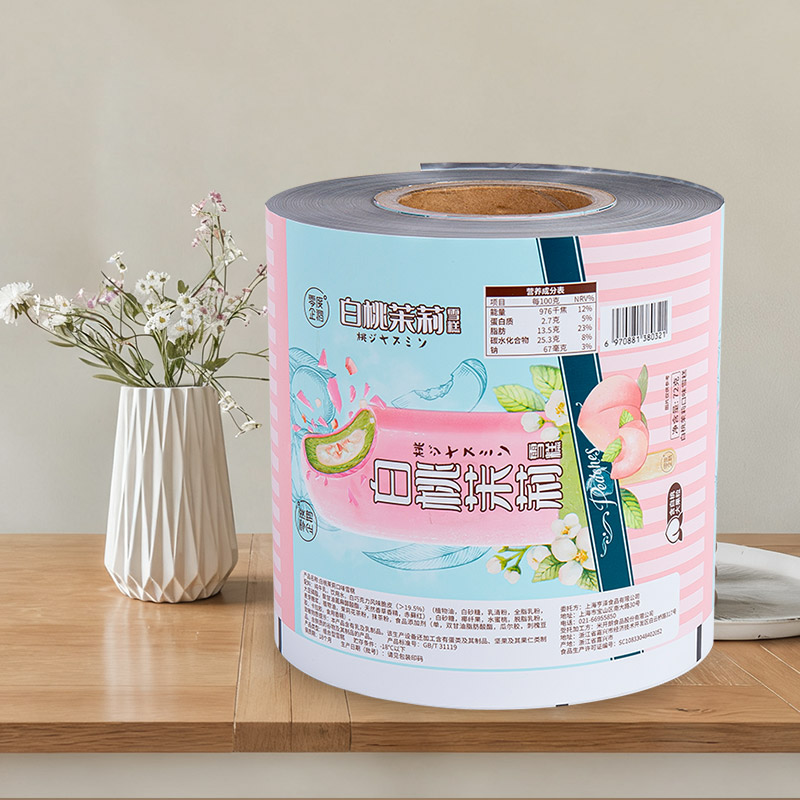
A laminate carrying a printed film roll needs particular attention, because ink, adhesive and film thickness all shift the surface the sled actually touches. Low-temperature applications add another variable, since some polymers stiffen and their friction rises as the temperature falls.
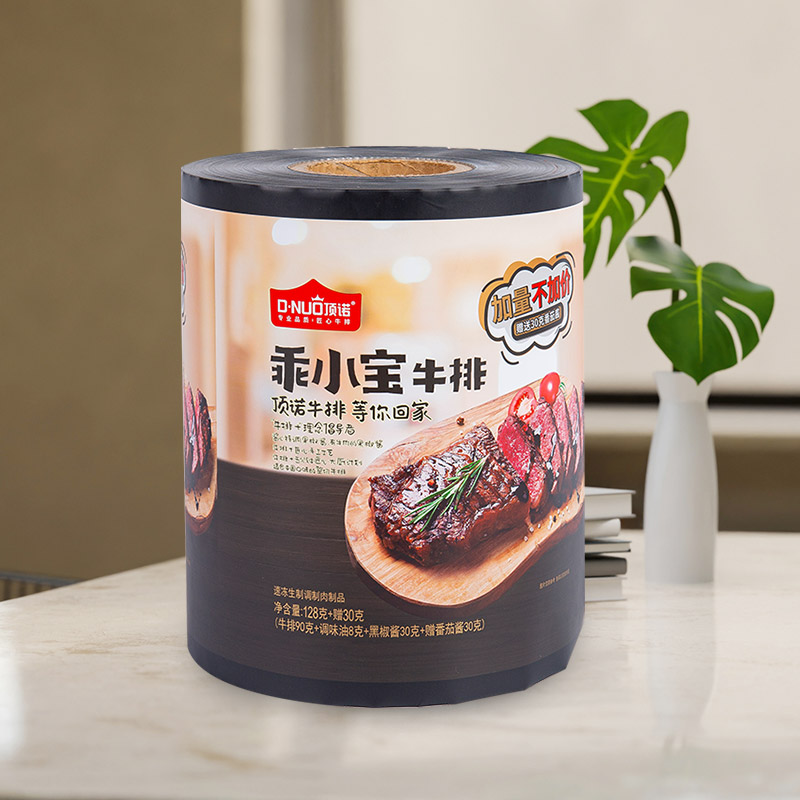
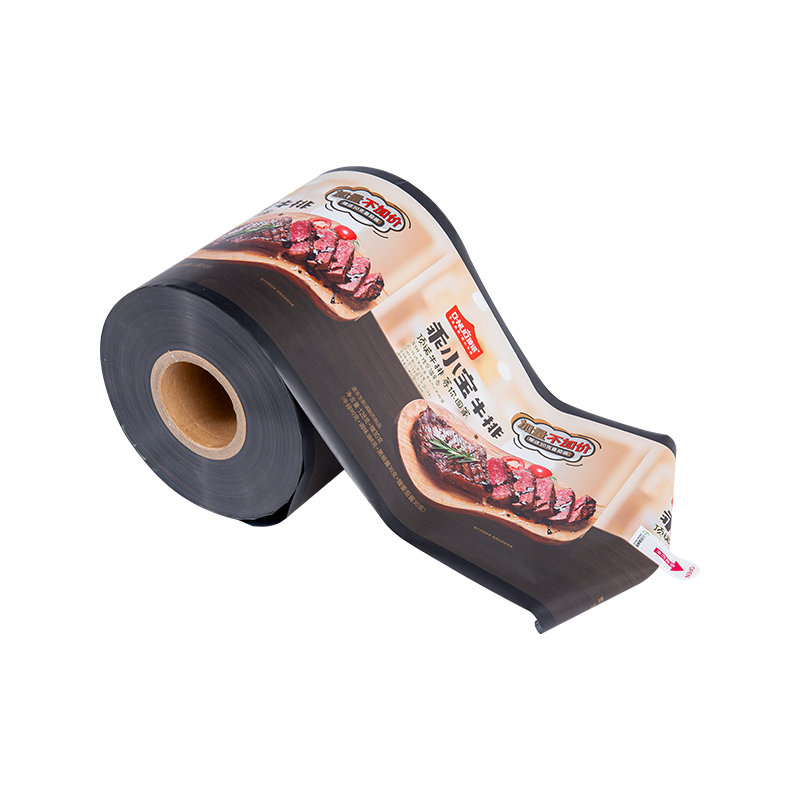 Printed High Barrier Steak Film Roll for Frozen MeatThis puncture-resistant printed roll combines EVOH barrier, -40°C cold resistance and steak graphics for fresh or frozen meat packaging where friction can change over time.View Product →
Hidden Variables: What COF Does in the Thirty Days After the Lab Report
A film that tested at 0.48 on day one can slide at 0.16 by month three. Slip additives are designed to migrate to the surface, and migration does not stop when the certificate is issued. The chart below shows a typical progression for a polyethylene film dosed with roughly 1,500 ppm erucamide.
- Temperature accelerates everything. As a rule of thumb, migration roughly doubles for every 10 °C rise. A 35 °C warehouse is a different film from a 20 °C warehouse.
- Over-slip is as costly as under-slip. Below 0.15 the film slides off the roll, wraps telescope, and pouches fan out in the case packer.
- Corona decay. Surface treatment fades over months, pulling print adhesion and friction in the same slow drift.
- Humidity hits nylon hardest. PA layers absorb moisture, change modulus and change friction, which is why conditioning before testing is not optional.
Where COF Matters Most: Application Distribution
Not every product category is equally sensitive to friction. High-speed filling, large bag formats and heavy fill weights concentrate the risk. The split below reflects the specification work we handle across flexible packaging categories.
- Coffee and tea packaging: 30 %
- Pet food, including large-format dog food: 22 %
- Frozen food, seafood and frozen pet food: 18 %
- Snacks and confectionery: 15 %
- Personal care and household liquids: 10 %
- Other industrial and medical uses: 5 %
Frozen formats deserve special mention. A high-barrier frozen seafood bag must hold its oxygen and moisture barrier at -18 °C while the outer film still feeds through the machine without slipping or snagging, so the COF window is often narrower than for ambient products.
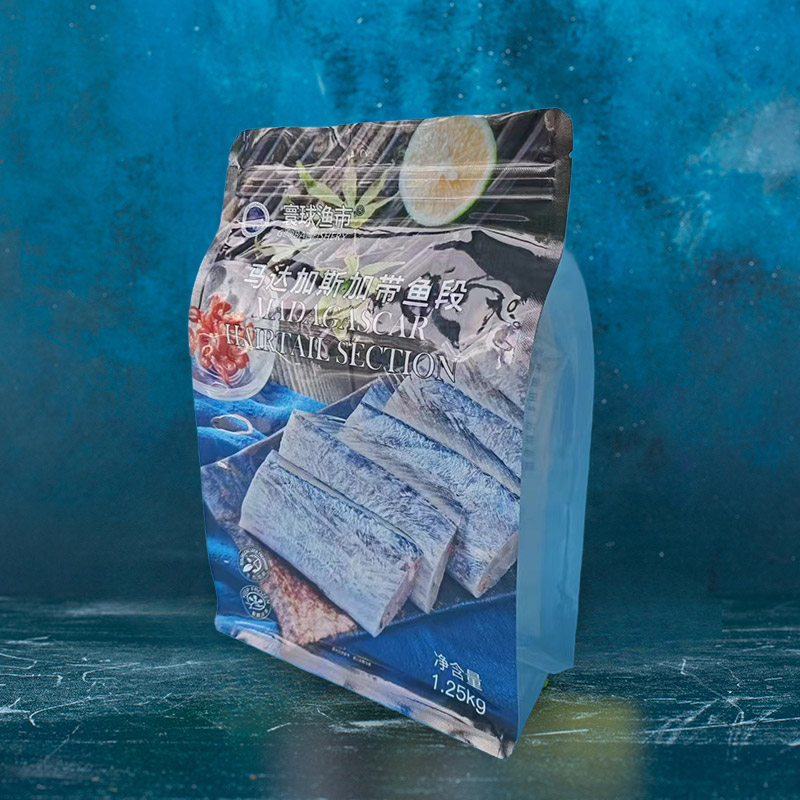
 High Barrier Frozen Seafood Bag for Low-Temperature PackagingThis multilayer frozen seafood bag targets -18°C storage with barrier and leak-proof properties, relevant when checking film-to-film and film-to-metal friction values.View Product →
Specifying COF: A Six-Step Qualification Workflow
Define the contact pair
Film-to-film for unwinding and stacking, film-to-metal for the forming collar, guides and sealing jaws. Ask for both numbers.
Fix the method
State ASTM D1894 or ISO 8295, sled mass, sliding speed and contact partner. A COF figure without a method is not a specification.
Condition the samples
24 hours at 23 °C and 50 % relative humidity, tested on the sealant face for form-fill-seal film.
Set a window, not a point
For example, kinetic COF 0.20 to 0.30 film-to-film, verified on every incoming batch rather than once at development.
Trial at production speed
A short roll at reduced speed proves little. Run at the target packs per minute with the real fill weight and sealing profile.
Freeze the formulation
Record slip additive type and ppm, corona level and layer position, so a well-meant resin swap does not silently reset friction.
The arithmetic favours the effort. One hour of friction-related downtime on a 60 packs per minute line is up to 3,600 unproduced packs, plus scrap, plus the labour of clearing jams. A single incoming COF test costs a few minutes.
Storage, Maintenance and Compliance Notes
- Store rolls below 30 °C, out of direct sunlight and away from heat sources. Warm storage accelerates additive migration and quietly narrows your usable window.
- Keep rolls in their original wrap until they go on the machine, and rotate stock first in, first out.
- Avoid stacking heavy pallets on soft film. Sustained pressure encourages blocking, which shows up later as a friction reading that no longer matches the certificate.
- For slip-critical structures, use the film within about six months of production and re-test retained samples periodically.
- Slip agents such as erucamide and oleamide migrate into food contact surfaces. Confirm the specific migration limit and the food-contact declaration for the exact grade, whether under EU 10/2011 or the equivalent FDA framework, and check the additive is cleared for the fat or aqueous simulant your product represents.
- Whenever you change ink, adhesive or lamination order, re-measure COF as part of the change control, not after the first complaint.
Reliable COF data starts with controlled process and records that hold up over time. Our quality control procedures cover the incoming checks that keep a specification meaningful between batches.
If you take one thing from this page, take the number: kinetic COF between 0.20 and 0.35 film-to-film is where most flexible packaging runs comfortably, and 0.15 to 0.45 is where it becomes risky. Everything else, the additives, the conditioning, the storage temperature, the layer order, is a way of holding the film inside that window for the full shelf life of the roll, not just on the day the sample was cut.