 EN
EN
 English
 日本語
日本語 Español
 Deutsch
 عربى
عربى
A juice pouch left in a warehouse for three months. A sauce refill bag exposed to summer heat during shipping. A detergent pouch sitting on a retail shelf for six weeks. In each case, the packaging material — not the product formulation — determines whether what reaches the consumer is still fresh, safe, and sellable. That's the core argument for high barrier flexible packaging in liquid spout pouches: the structure of the film is as important as anything inside it.
Content
Why High Barrier Performance Matters in Liquid Spout Pouches
Three external factors degrade liquid products in packaging: oxygen ingress, moisture vapor transmission, and UV light exposure. For most liquids — beverages, sauces, personal care formulations, household cleaners — any one of these, given enough time or intensity, will alter flavor, reduce efficacy, accelerate spoilage, or trigger chemical reactions with the product itself.
Oxygen is the primary concern for food and beverage applications. Even trace amounts accelerate oxidation, producing off-flavors in juices and oils, and reducing the potency of vitamin-fortified drinks. Standard flexible films allow oxygen transmission rates that shorten effective shelf life by weeks; high barrier structures reduce this by orders of magnitude, enabling the shelf-life parity with glass or metal that brand owners expect from modern flexible packaging.
Moisture vapor transmission works in both directions. For liquid products, the risk is evaporative loss — concentrated sauces or personal care products changing in viscosity or concentration over time. For hygroscopic powdered additives sometimes combined with liquid packaging, moisture ingress causes clumping and product degradation. A well-specified barrier film controls both directions simultaneously.
Light sensitivity is often underestimated. Opaque aluminum foil layers block UV entirely; for translucent pouches designed to show the product, UV-blocking coatings or tinted films provide a middle path. The choice depends on whether product visibility is a marketing priority that outweighs the light-protection benefit.
How Multi-Layer Composite Films Create the Barrier
No single polymer film delivers every property a liquid spout pouch requires. High barrier performance in flexible packaging is always a result of lamination — bonding multiple functional layers into a composite structure where each layer handles a specific job.
A typical PET/AL/PE structure illustrates this clearly. The outer PET (polyethylene terephthalate) layer provides mechanical strength, puncture resistance, and a stable surface for high-quality printing. The middle aluminum foil layer — usually 7–12 microns — delivers near-absolute barrier against oxygen, water vapor, and light. The inner PE (polyethylene) layer contacts the product directly, providing food-safe inertness, heat-seal capability, and the flexibility needed to form a reliable weld at the spout fitment.
PA/PE (nylon/polyethylene) structures follow the same logic without the aluminum layer. Nylon contributes excellent puncture resistance and moderate oxygen barrier; PE handles sealing and product contact. This construction is common for products where some degree of transparency is desirable and where barrier requirements are moderate rather than extreme — many sauce and condiment pouches fall into this category.
For applications requiring maximum shelf life without aluminum foil — increasingly relevant as brands seek more sustainable or recyclable constructions — high-barrier coextruded film with enhanced barrier function using EVOH (ethylene vinyl alcohol) as the barrier layer offers a viable alternative. EVOH provides outstanding oxygen barrier in dry conditions, though its performance is sensitive to moisture, making film structure design critical.
Matching Barrier Structures to Your Liquid Product
The right barrier structure depends on what you're packaging, how long it needs to remain stable, and what environmental conditions it will face between filling and consumption. The following framework covers the most common liquid spout pouch applications.
| Product Type | Primary Threats | Recommended Structure | Key Requirement |
|---|---|---|---|
| Juices & beverages | Oxygen, light, flavor loss | PET/AL/PE | Low OTR, full light block |
| Sauces & condiments | Oxygen, moisture loss | PET/PA/PE or PET/AL/PE | Puncture resistance, good seal strength |
| Liquid detergents | Chemical compatibility, leakage | PET/PE (multi-layer) | Chemical resistance, hermetic spout seal |
| Personal care liquids | Contamination, oxidation | PET/AL/PE or BOPP/AL/PE | Product inertness, printability |
| Baby food & purees | Oxygen, microbial risk | PET/AL/PE (retort-grade) | High-temp sterilization tolerance |
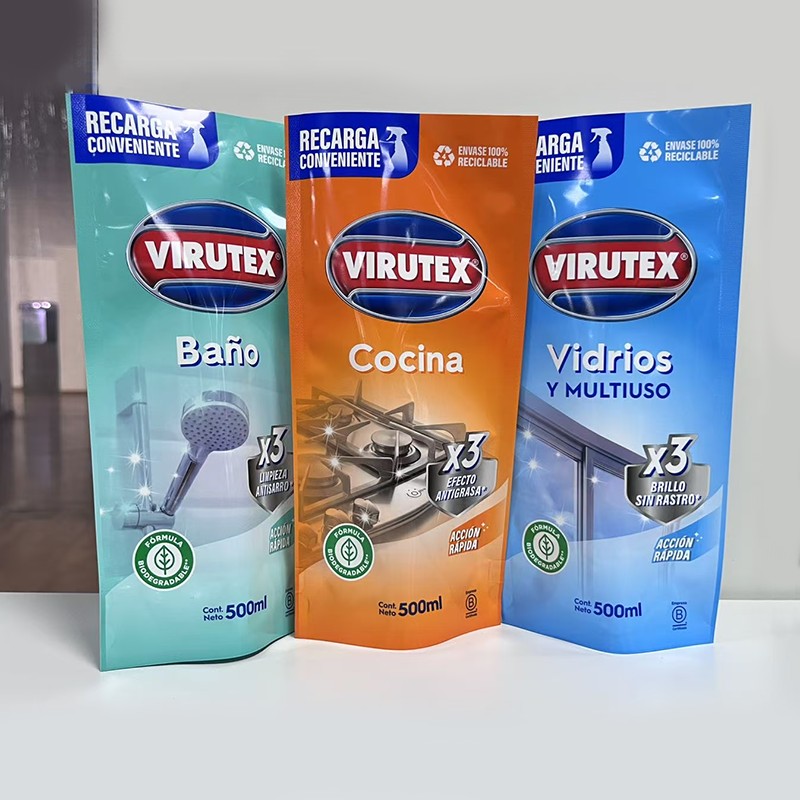
Liquid detergent deserves specific attention. The chemical aggressiveness of surfactant-based formulations places unusual demands on the inner film layer — standard PE grades are adequate for food products but may be insufficient for concentrated alkaline or acidic cleaners. Verified chemical compatibility testing between the product formula and the film construction is essential before committing to a production run. Our spout pouches for liquid detergent with reliable sealing performance are designed specifically to address these compatibility and seal-integrity requirements.
For retort applications — pouches that undergo high-temperature sterilization after filling — the entire laminate structure must withstand sustained temperatures above 121°C without delamination, seal failure, or barrier degradation. Not all aluminum foil grades and adhesive systems are suitable for retort conditions; this is a specification that must be confirmed with the film supplier before tooling or production begins.
Beyond Barrier: Other Performance Demands of Liquid Spout Pouches
Barrier performance is the headline property, but it's not the only one that determines whether a liquid spout pouch performs reliably in the real world. Several mechanical and process-related requirements deserve equal attention during specification.
Seal strength and spout fitment integrity are the most direct determinants of leakage risk. The heat-seal bond between the film layers at the pouch perimeter, and particularly the ultrasonic or heat weld between the film and the spout fitment, must withstand internal pressure during filling, vacuum during sealing, and mechanical stress during transit. Drop testing — simulating the impact of a filled pouch falling from shelf height — is a standard quality validation step for any new pouch specification.
Puncture and abrasion resistance matter for pouches that will be shipped in mixed loads or handled repeatedly by consumers. Nylon (PA) layers contribute significantly here; for pouches where aluminum foil is the barrier layer, the relatively brittle nature of foil means that flex cracking along fold lines can compromise barrier integrity over time. Pouch geometry — avoiding sharp corners and specifying adequate gusset depth — reduces the stress concentration that leads to flex cracks.
Filling line compatibility is a practical constraint that narrows material choices more than many buyers anticipate. Film stiffness, seal temperature window, coefficient of friction, and anti-static properties all affect how a pouch behaves on automated filling and sealing equipment. Specifying a film that delivers excellent barrier but runs inconsistently on the production line creates a different kind of quality problem — one that shows up as downtime and rejects rather than shelf-life failures.
Flexible Packaging vs Rigid Containers for Liquid Products
Rigid containers — glass bottles, HDPE jugs, metal cans — have been the default for liquid products for decades. The case for converting to liquid spout pouches in high barrier flexible packaging is now well-established across multiple industries, driven by measurable advantages rather than novelty.
Weight reduction is the most immediate financial argument. A filled 500ml glass bottle weighs roughly four times more than an equivalent spout pouch. Across a pallet of product, this difference translates directly into freight cost savings and reduced carbon footprint per unit shipped. For brands selling through e-commerce channels — where dimensional weight pricing amplifies the cost of heavy packaging — the savings per shipment are material.
Storage and logistics efficiency extends to the packaging supply chain itself. Empty pouches occupy a fraction of the warehouse space of pre-formed rigid containers. A pallet of flat, unfilled spout pouches replaces multiple pallets of bottles or cans, reducing inbound logistics costs and improving production scheduling flexibility.
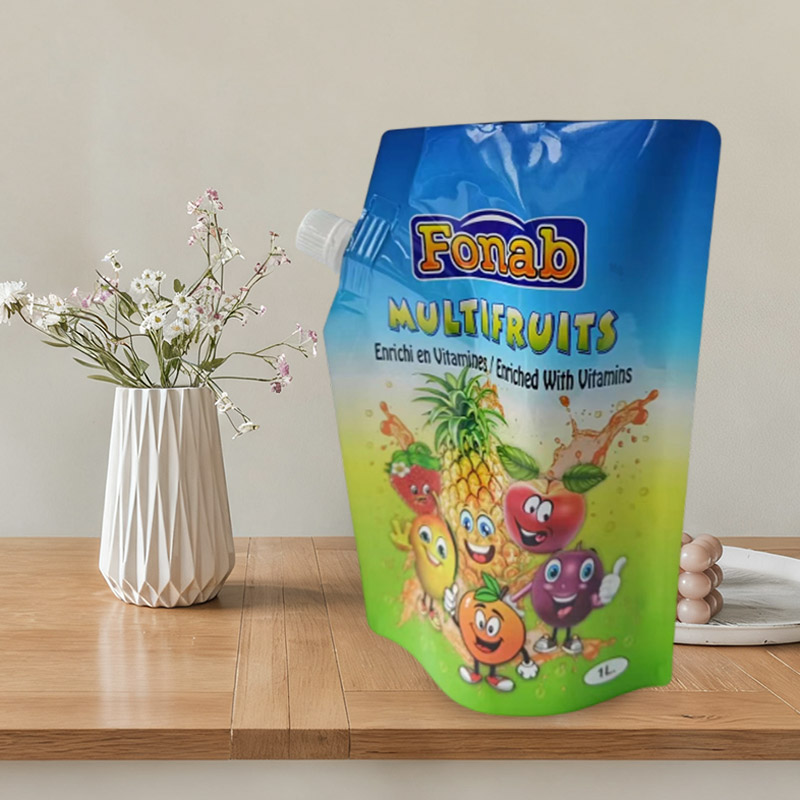
From a consumer experience standpoint, spout pouches offer resealability, precise dispensing control, and ergonomic handling that rigid containers cannot match at equivalent cost. The ability to stand upright on shelf and dispense without dripping has made spout pouches the preferred format across categories from baby food to premium olive oil to refillable household cleaners.
The flexibility of the format also enables source reduction. A spout pouch uses significantly less material per unit of product contained compared to rigid alternatives — a direct sustainability benefit that brand owners can quantify and communicate. Explore our stand-up pouch options for food and beverage applications and our full flexible packaging product range to find the right solution for your liquid product.