 EN
 English
 日本語
 Español
 Deutsch
 عربى

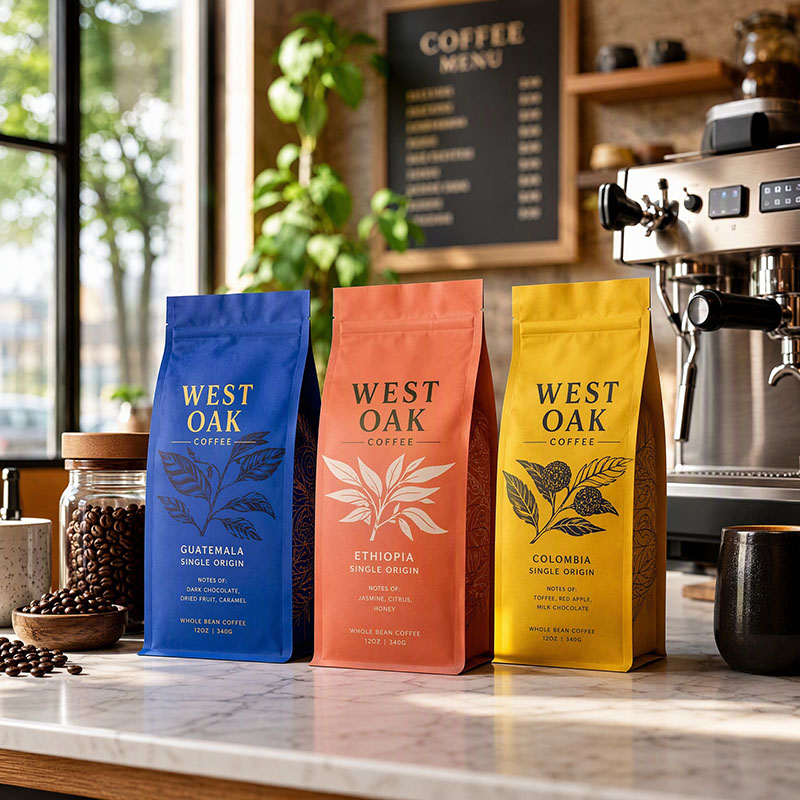
A roastery approves a 340 g stand-up pouch, fills it with a light-roast Kenyan, and finds the bag only closes cleanly at 295 g. Nothing is wrong with the pouch. The fill weight was specified in ounces, the pouch volume was specified in millimetres, and nobody reconciled the two numbers before the order went to print.
Coffee bag sizes are a volume decision wearing a weight label. Once a brand treats them that way, the spec - grams, outer dimensions, valve position, film area per kilo - locks together in one pass.
The short version
- Retail clusters around 250 g, 340 g (12 oz), 454 g (1 lb) and 500 g; wholesale clusters around 1 kg and above.
- 340 g is the default US retail unit, but it is not a bag dimension. A light roast needs roughly 8 to 12 percent more volume than a dark roast at the same weight.
- Fill to 75 to 85 percent of pouch volume. The remaining headspace is what keeps the one-way valve working and the seams flat.
- Packaging film per 100 g falls by more than half between a 250 g and a 1 kg format, which changes both cost and recyclability claims.
Content
- 1 Standard Coffee Bag Sizes, Stated Plainly
- 2 Why Fill Weight and Pouch Volume Are Two Different Numbers
- 3 The Same Fill Weight in Three Different Bag Formats
- 4 Comparing Six Common Sizes Side by Side
- 5 The Hidden Metric: Film Weight per 100 g of Coffee
- 6 Where Each Size Sits in the Market
- 7 Small Runs Do Not Have to Buy a Large Minimum
- 8 A Six-Step Sizing Workflow
- 9 Compliance, Storage and Change Control
Standard Coffee Bag Sizes, Stated Plainly
There is no single global standard, but the market has settled into a small set of units that repeat across retail shelves, subscription programmes and food service. If you are specifying packaging for the first time, these are the numbers you will actually be quoted against.
- 125 g and below - sample and gifting sizes, often a tin tie or a small flat pouch. Useful for trials, weak on shelf presence.
- 250 g - the European, UK and Japanese retail default. Roughly 15 cups at 16 g per brew.
- 340 g (12 oz) - the US retail core. Roughly 21 cups. Highest-volume single unit in most markets.
- 454 g (1 lb) and 500 g - value retail and club formats. Roughly 28 and 31 cups.
- 1 kg and 2 kg - wholesale, cafe back-bar and food service. Roughly 62 cups per kilo.
Treat cup counts as planning aids, not promises. A home filter dose runs 10 g to 18 g, so a 340 g bag can honestly be described as anything between 19 and 34 cups. Retail buyers increasingly ask for the dose assumption, not the number.
Why Fill Weight and Pouch Volume Are Two Different Numbers
Roasted whole bean bulk density typically falls between 0.30 and 0.38 g per cubic centimetre depending on roast level and origin. Dark roasts sit at the low end because the bean has lost more mass and expanded; light roasts sit higher. Ground coffee compresses to roughly 0.45 to 0.50 g per cubic centimetre. That spread is why the same 340 g can require two different pouch sizes across a product range.
A workable specification formula is volume equals fill weight divided by bulk density, then divided again by a fill ratio of 0.80. For 340 g of whole bean at 0.34 g per cubic centimetre, that lands near 1,250 cubic centimetres of usable pouch volume - which is why a 140 x 230 mm stand-up pouch with a 70 mm bottom gusset is such a common fit.
Headspace allowance
Keep 15 to 20 percent of internal volume free. Less than that and seams bulge during degassing; more and the bag looks underfilled on shelf.
Valve clearance
A one-way valve needs a flat, uncreased panel of about 20 mm. On a small 125 g pouch this can consume most of the front face.
Zipper take-up
A press-to-close zipper eats 8 to 12 mm of usable height at the top of the bag. Recount the fill weight after adding one.
The Same Fill Weight in Three Different Bag Formats
Format decides how much shelf width a size occupies and how much printable area you get. A three-side-seal pouch in 340 g is compact and cheap but stands only when tightly filled. A stand-up pouch with a bottom gusset holds its shape and gives one clean front panel. A flat bottom pouch, or an eight-side seal with side gussets, adds two more panels and a rigid box silhouette - which is why premium roasters drift toward it at 500 g and above.
A practical rule: below 250 g, format choice is mostly a cost and print decision; above 500 g it becomes a structural one, because the bottom gusset has to carry the weight without sagging. Valve behaviour, film stiffness and the seam schedule matter more than the artwork at that point. The mechanics of valve and reseal choice are covered in this guide to coffee bags with valves and resealable closures.
Comparing Six Common Sizes Side by Side
The comparison below assumes whole bean in a gusseted format and gives indicative outer dimensions. Ground coffee usually drops one size band because it packs tighter.
Indicative outer dimensions for whole bean; ground coffee packs 8 to 12 percent tighter and often needs one band smaller.
Most roasters need two sizes, not six: one retail unit that matches their average basket, and one 1 kg or 2 kg unit for wholesale accounts. A third size only earns its place when a specific channel demands it.
The Hidden Metric: Film Weight per 100 g of Coffee
Packaging cost per bag rises with size, but packaging cost per kilogram of coffee falls sharply. That gap is invisible on a quote sheet and it drives both margin and sustainability claims. The bars below show indicative film consumption per 100 g of packed coffee for a standard high-barrier structure.
Two practical consequences follow. First, moving a wholesale account from six 1 kg bags to one 5 kg bag cuts film consumption by roughly 58 percent for the same coffee. Second, per-unit cost comparisons between suppliers are meaningless if the fill weights differ - always normalise to cost per kilogram packed.
Where Each Size Sits in the Market
Across retail coffee listings, the weight distribution is heavily concentrated. The split below reflects typical retail and wholesale mix rather than any single market.
- 340 g - 32 percent. The single most specified retail weight.
- 454 g - 21 percent. Value retail and club packs.
- 1 kg - 18 percent. Wholesale and cafe supply.
- 250 g - 17 percent. Europe, UK, Japan and subscription.
- 500 g - 8 percent. Premium mid-tier.
- 125 g and below - 4 percent. Samples, gifts, limited lots.
Small Runs Do Not Have to Buy a Large Minimum
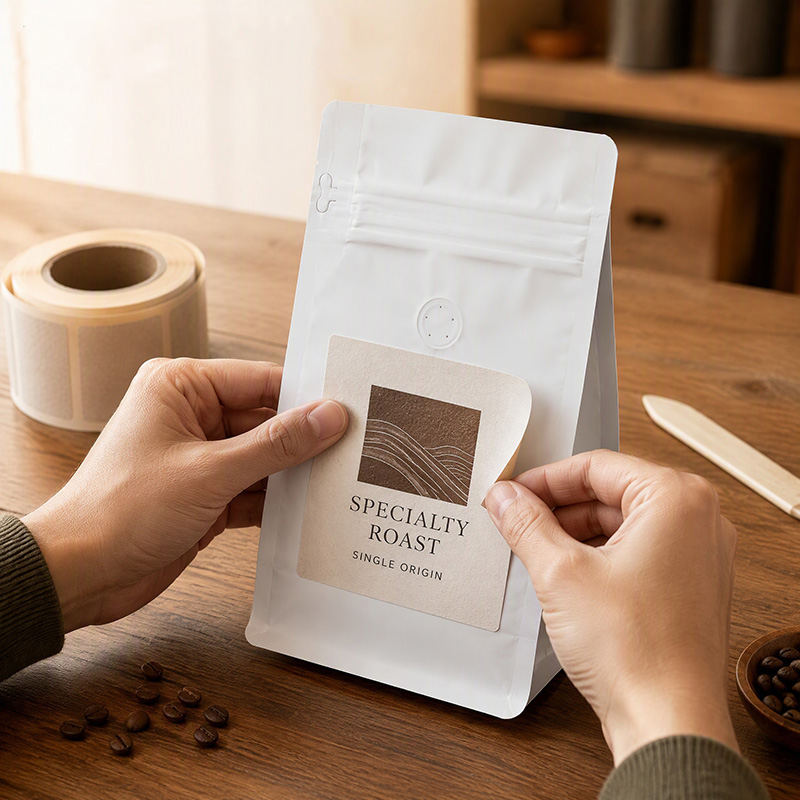
The most common sizing mistake among new roasters is committing to a 340 g printed pouch before they know their sell-through. A safer sequence is to launch in a plain high-barrier bag with a pressure-sensitive label, learn the actual weight that sells, then invest in printed film once the number is stable. Digital printing now makes a 500 to 1,000 piece run viable across two or three sizes, which is enough to test 250 g against 340 g without carrying a year of inventory.
A Six-Step Sizing Workflow
This is the order that avoids expensive rework. Steps one to three can be done with a scale and a calculator; steps four to six need samples in hand.
1. Fix the dose
Decide the brew dose you will print on pack, then derive cups from it. Do not copy a competitor's cup count.
2. Measure density
Fill a 1,000 ml container with your actual product and weigh it. Do this for each roast level you sell.
3. Calculate volume
Divide fill weight by density, then divide by 0.80. Round up to the nearest standard pouch volume.
4. Test the format
Fill three empty bags by hand. Check seam flatness, valve clearance and how the bag stands at 80 percent fill.
5. Run abuse tests
Drop from 1.2 m, stack for 72 hours, and hold at chilled and warm conditions. Watch the bottom gusset first.
6. Lock the drawing
Approve a dimensioned artwork file plus a signed fill-weight tolerance, typically plus or minus 2 percent.
Compliance, Storage and Change Control
Three regulatory points touch bag sizing directly. Net quantity declarations must reflect the actual fill, so a nominal 340 g bag that averages 335 g is a labelling problem in most jurisdictions. Food-contact compliance - EU 1935/2004 and its migration testing, or FDA food-contact notification in the US - attaches to the full structure, so changing from a three-layer to a four-layer film to fit a new size reopens the question. Recyclability claims depend on the material, not the format, but a mono-material structure in a 1 kg eight-side seal behaves differently on a form-fill line than the same film at 250 g.
Barrier targets should be written into the specification rather than assumed. For roasted coffee, an oxygen transmission rate below 1 cc per square metre per day and a water vapour transmission rate below 1 g per square metre per day are common targets for a 12-month shelf life, but the number you need depends on roast, grind and distribution temperature. Document seal strength, drop performance and headspace oxygen at release, then re-verify after any film or size change. Our quality control process sets out how these checks are recorded batch by batch.
One last note on storage. A larger bag is not automatically more wasteful - a 5 kg bag uses less film per kilo than six 1 kg bags - but it exposes the coffee to repeated opening cycles unless it reseals properly. Match the size to the actual consumption cycle of the buyer, not to the wholesale price break.