 EN
 English
 日本語
 Español
 Deutsch
 عربى

A chocolate tablet wrapped at 700 packs per minute will reject more output in a single shift because of a 1–2 mm cocoa-dust smear across the seal than because of a film gauge error. On a gummy line, one hard sugar crystal trapped in the jaw stops the machine within seconds, while a barrier shortfall stays invisible for eight weeks and then returns as a customer complaint. Both failure modes sit at the same place: the interface between the process and the pack.
The practical answer, before any film data sheet is opened, is to pick the format and the sealant from the sealing window backwards. Decide whether the product can survive a hot jaw at all, how much dust or syrup will be sitting in the seal area, and only then set the moisture and oxygen targets. Barrier performance is the last variable to optimise, not the first.
The short version
- Heat-sensitive chocolate, pralines and coated centres belong on pressure-only cold seal, not on hot jaws.
- Dusty, crystalline or oily fillings need a wider seal and a thicker sealant, validated with real product on a real line.
- Moisture and fat migration must be written as numbers with test conditions, then confirmed in a 40 °C warehouse trial.
Everything below follows from those three points. The sections move from process constraints to format comparison, then to the barrier figures most specifications omit, and finally to the maintenance and compliance details that decide whether the approved pack still runs cleanly twelve months later.
Content
- 1 Six Constraints That Decide the Film Before the Artwork Does
- 2 Comparing Five Formats on the Metrics Buyers Actually Audit
- 3 The Figure Most Specifications Leave Out
- 4 Where Flexible Packaging Actually Sits in Confectionery
- 5 A Six-Step Route From Brief to Approved Pack
- 6 Maintenance, Compliance and the Questions Buyers Forget
Six Constraints That Decide the Film Before the Artwork Does
Confectionery is one of the few food categories where the process upstream dictates the packaging structure almost completely. These six constraints appear repeatedly in line trials, and each one has a measurable answer.
1. Tempered chocolate cannot absorb heat
Sealing jaws at 130 °C will visibly mark a tablet surface within milliseconds. Cold seal adhesive transfers by pressure alone, which is why bar wrappers still use it. The trade-off is reel discipline: adhesive blocks if stored above roughly 25 °C.
2. Sugar dust is the real seal killer
A 0.1 mm crystal in the seal zone creates a leak channel through an otherwise perfect weld. Wider seals of 5–8 mm, sealant layers of 30–40 µm and high hot-tack resins buy tolerance that a thin sealant cannot.
3. Moisture switches on bloom
Sugar bloom follows condensation on a cold tablet; gummies lose water and harden at the edges. Both are water-vapour problems, and both are solved by a barrier layer rather than by a colder warehouse.
4. Fat and nut oils migrate sideways
Cocoa butter and nut oils wick through sealant films and stain print. Aluminium foil, metallised layers or EVOH structures slow that migration; plain PE does not.
5. Friction sets the line speed ceiling
Dynamic coefficient of friction is usually specified between 0.2 and 0.4 on the outside face. Below that, the web tracks poorly on rollers; above it, drag causes registration drift on printed reels.
6. Seasonal SKUs break print budgets
Halloween, Easter and gifting ranges multiply artwork versions on shrinking volumes. Digital print removes cylinder cost and allows a short run per variant, at the price of a narrower substrate menu.
Comparing Five Formats on the Metrics Buyers Actually Audit
Format decisions are usually made on appearance and then justified on cost. The comparison below starts from the process side instead: seal type, achievable barrier and the run length at which each format stops being economical.
Caption-style note: barrier figures are typical starting points at 38 °C and 90% relative humidity; the fill weight, headspace and distribution route can move the real requirement by a factor of two.
One pattern holds across the table. The formats with the best barrier are rarely the fastest, and the fastest rarely accept a zipper. A brand selling 120 g gummy bags and 1 kg sharing packs usually ends up with two structures rather than one compromise structure. For sugar-heavy catalogues, the pouch options in candy and gummy packaging pouches show how format and barrier are paired in practice.
The Figure Most Specifications Leave Out
Water-vapour transmission is usually quoted as "high barrier" in a brief and as a single number on a data sheet, without stating the test conditions. That ambiguity costs money. The chart below shows commonly targeted ceilings by product type, expressed in grams per square metre per 24 hours at tropical conditions.
Oxygen transmission matters just as much once nuts, nougat or milk fat are involved, because rancidity develops long before texture changes. A structure that holds moisture but lets oxygen through will pass a three-week test and fail a nine-month shelf life. Multi-layer films with an EVOH core address both vectors at once, and the selection logic for EVOH high-barrier packaging films explains where that core layer earns its cost.
Where Flexible Packaging Actually Sits in Confectionery
Flexible formats dominate because confectionery is sold by weight, needs barrier per gram of product, and is often displayed in shelf-ready trays. The split below reflects typical format usage across retail confectionery ranges rather than a single market study.
- Cold-seal flow wrap — 42%
- Stand-up and flat-bottom pouches — 24%
- Thermoformed and blister — 12%
- Spout and liquid pouches — 9%
- Paper and kraft formats — 8%
- Compostable and mono-material — 5%
The paper segment is growing faster than its share suggests, but it usually hides a plastic or metallised inner layer for barrier. Buyers who assume a kraft outer surface makes the pack recyclable are frequently wrong, and that assumption is now expensive in markets with extended producer responsibility fees.
A Six-Step Route From Brief to Approved Pack
Step 1 — Fix the product window
Record heat sensitivity, surface hardness, fat content and expected shelf life. These four facts eliminate half of the format menu immediately.
Step 2 — Choose the seal system
Cold seal for heat-sensitive coated products, hot jaw for everything that tolerates 110 °C and above. Never mix the two on one SKU family.
Step 3 — Write barrier numbers
State WVTR and OTR ceilings with temperature, humidity and test method. A number without conditions cannot be verified by anyone.
Step 4 — Prove seal-through-dust
Run a contamination trial with real product at production speed, then dye-test the seals. This is the step that most prototypes skip.
Step 5 — Shelf test at 40 °C
Four weeks at 40 °C and 75% RH approximates roughly twelve months at ambient. Score bloom, texture and aroma, not only appearance.
Step 6 — Match print to volume
Gravure for stable long runs, digital for seasonal variants. Splitting the range between the two usually beats forcing everything onto one process.
Steps four and five are where projects slip. A structure that seals perfectly on a lab sealer can fail on a vertical form-fill-seal machine with 0.4 seconds of dwell time, and the difference is usually sealant thickness rather than the barrier layer.
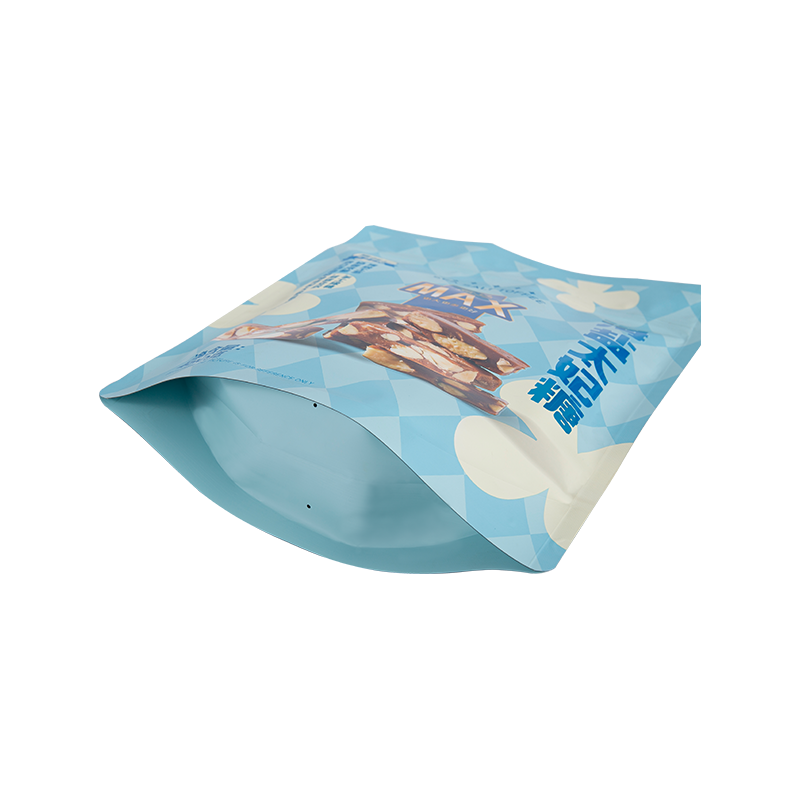 Vibrant Color Digital Printed Low-MOQ Snack PouchesDigitally printed snack pouches support small seasonal and gifting runs, with sealant thickness and machine compatibility worth validating before production.View Product →
For limited-edition and gifting ranges, digital printed pouches keep cylinder costs out of the calculation and let a seasonal run start at a few thousand units instead of a few hundred thousand.
Maintenance, Compliance and the Questions Buyers Forget
Most packaging complaints that survive the line trial are maintenance or documentation issues rather than film design errors. Four of them account for the majority.
- Cold seal reels age. Adhesive stored above 25 °C or used past its shelf life loses tack and blocks on the reel, which looks exactly like a supplier defect.
- Jaw condition changes results daily. Worn PTFE tape, uneven pressure and dried sugar residue all reduce seal strength without anyone touching the film specification.
- Migration testing must use fatty simulants. Chocolate and praline packs tested with aqueous simulants only will not satisfy EU 10/2011, FDA 21 CFR 177 or GB 4806.7 requirements.
- Recyclability claims need proof. Mono-material PE structures typically need a density below 0.93 g/cm³ to pass density-based sorting, and the claim must match national guidance.
- Mineral oil and NIAS declarations matter when recycled fibre is anywhere near the pack, even if the food-contact layer is plastic.
Sustainability conversations now arrive with the brief rather than after it, because extended producer responsibility fees are calculated per material and per weight. A mono-material construction that keeps the same barrier performance removes a sorting penalty and often a fee band at the same time.
 PE Recyclable Refill Stand-Up Spout PouchMono-material PE refill pouch supports recyclability and EPR material-fee goals, while its sealant and filling-temperature tolerance should be checked on existing lines.View Product →
Recyclable mono-material pouches show what that looks like in production: one polymer family, a defined density window and a sealant thick enough to run on existing fill lines. The trade-off is a narrower temperature tolerance during filling, which is worth measuring before the artwork is signed off.
Confectionery processing and packaging succeed or fail at the same small interface: the few millimetres where the jaw meets the film. Get the seal system right for the product's heat tolerance and dust load, write barrier targets as verifiable numbers, and confirm both across a full shelf-life test. Everything else — print, format, recyclability — can then be optimised without reopening the fundamentals.