 EN
EN
 English
 日本語
日本語 Español
 Deutsch
 عربى
عربى
Content
- 1 What Makes a Good Coffee Bean Bag Material
- 2 Why Aluminum Foil Remains the Benchmark for High Barrier Coffee Bag Material
- 3 The Role of Degassing Valves in Coffee Bag Material Performance
- 4 Matching Coffee Bag Material to Format and Volume
- 5 Sourcing High Barrier Coffee Bag Material With Consistent Quality
What Makes a Good Coffee Bean Bag Material
Roasted coffee begins losing quality the moment it leaves the roaster, and the packaging is what determines how much of that quality survives until the cup. A suitable coffee bean bag material needs to do three things at once: keep oxygen and moisture out, let excess gas escape, and hold up during transport and storage without tearing or delaminating. Single-layer films rarely meet all three requirements, which is why most coffee bags on the market today rely on multi-layer structures that combine different polymers and barrier layers into one laminate.
The choice of material also affects shelf appearance — a matte finish, print clarity, and how well the bag holds its shape on a retail shelf all depend on the base film and lamination quality, not just the printing process applied on top.
Why Aluminum Foil Remains the Benchmark for High Barrier Coffee Bag Material
Among the materials used in coffee packaging, aluminum foil continues to set the standard for barrier performance. A laminated aluminum layer blocks light, oxygen, and water vapor almost completely, which is exactly what's needed to protect the volatile aromatic compounds that give coffee its flavor. Without this level of protection, coffee beans can lose much of their aroma within weeks of roasting, even if the bag looks sealed and intact.
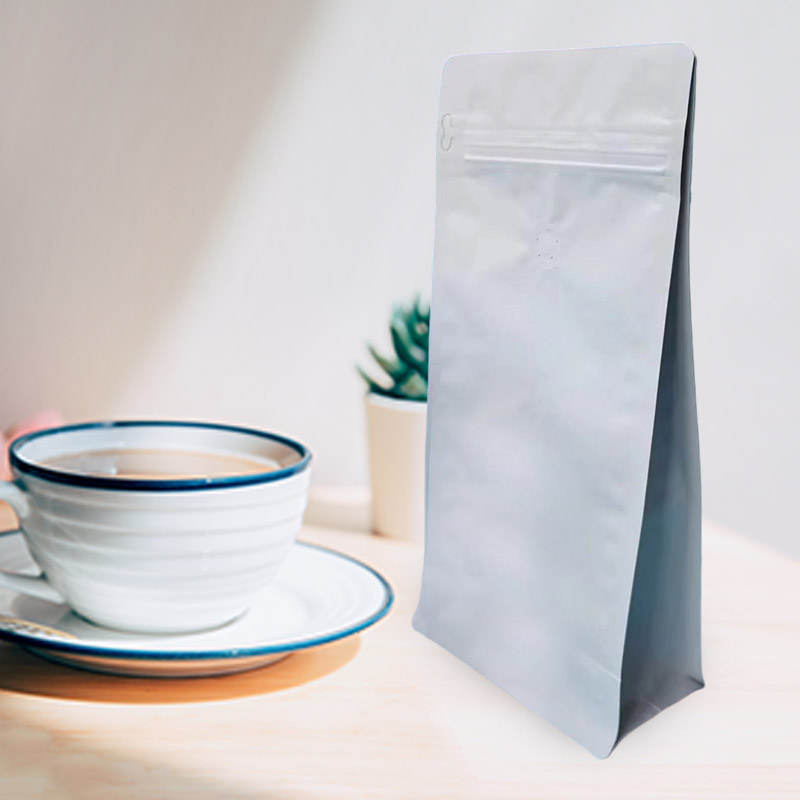
For roasters working with 250g, 500g, and 1kg formats, a matte aluminum-coated high barrier coffee bag material offers a practical balance: it protects freshness over the typical retail shelf life, gives a premium matte finish that suits specialty coffee branding, and works reliably across different bag styles — flat bottom, stand-up pouch, or block-bottom formats.
The Role of Degassing Valves in Coffee Bag Material Performance
Even the best barrier film creates a new problem if it's completely sealed: freshly roasted coffee continues to release carbon dioxide for days after roasting, and a fully airtight bag will simply inflate and risk seam failure. This is why a one-way degassing valve is paired with high barrier film in most modern coffee bags. The valve lets CO2 escape from inside the bag while preventing outside air and moisture from entering — preserving the integrity of the barrier layer while still allowing the bag to "breathe" in one direction only.
The combination of an aluminum-coated barrier film with a precision one-way valve is what allows roasters to package coffee immediately after roasting without waiting for off-gassing to subside, shortening the time between roasting and shelf-ready packaging.
Matching Coffee Bag Material to Format and Volume
| Bag Weight | Typical Use Case | Material Consideration |
|---|---|---|
| 250g | Retail single-bag, specialty coffee | Aluminum foil for maximum aroma retention |
| 500g | Café and home brewing | High barrier laminate, valve required |
| 1kg | Wholesale and food service | Reinforced seams, higher puncture resistance |
As bag size increases, the material needs to do more than block oxygen — it also has to withstand stacking pressure during storage and shipping, which is where lamination strength and seal quality become as important as the barrier rating itself.
Sourcing High Barrier Coffee Bag Material With Consistent Quality
For roasters scaling up production, consistency between batches matters as much as the initial barrier specification. Variations in foil thickness, lamination bonding, or valve placement can lead to inconsistent shelf performance even when the material specification on paper looks identical. We produce plain coffee bags in matte black and white finishes across 250g, 500g, and 1kg sizes, using aluminum-coated high barrier film paired with a Japanese-technology one-way degassing valve to ensure CO2 is released cleanly after roasting while oxygen and moisture stay out.
If you're evaluating coffee bean bag material for a new product line or switching suppliers, we're happy to share samples and barrier test data so you can compare performance directly against your current packaging.